
A customer calls your store with a question. Nobody picks up, so they hang up and buy somewhere else.
A missed call like that is one reason store owners ask what voice AI is, and whether it could answer. Search for it, and the first results mix several meanings of voice AI. Under Google’s AI summary, the first result for “what is voice AI” is Voice.ai, and its title starts “Free AI Voice Changer”.[1]
This guide answers the question for an online store. I’m Stefano Bertoli, founder of RuleInside, and I build AI voice agents for WordPress stores. So I sell what this guide describes, and I say where it fits badly too. I tested our own demo store’s agent for this guide, by text and by voice.
Key takeaways
- What is voice AI? For a store, it is an AI voice agent that answers calls, looks things up and talks back.
- A voice agent hears the caller, decides what to do and answers out loud. In conversation, people answer each other in about 200 milliseconds.
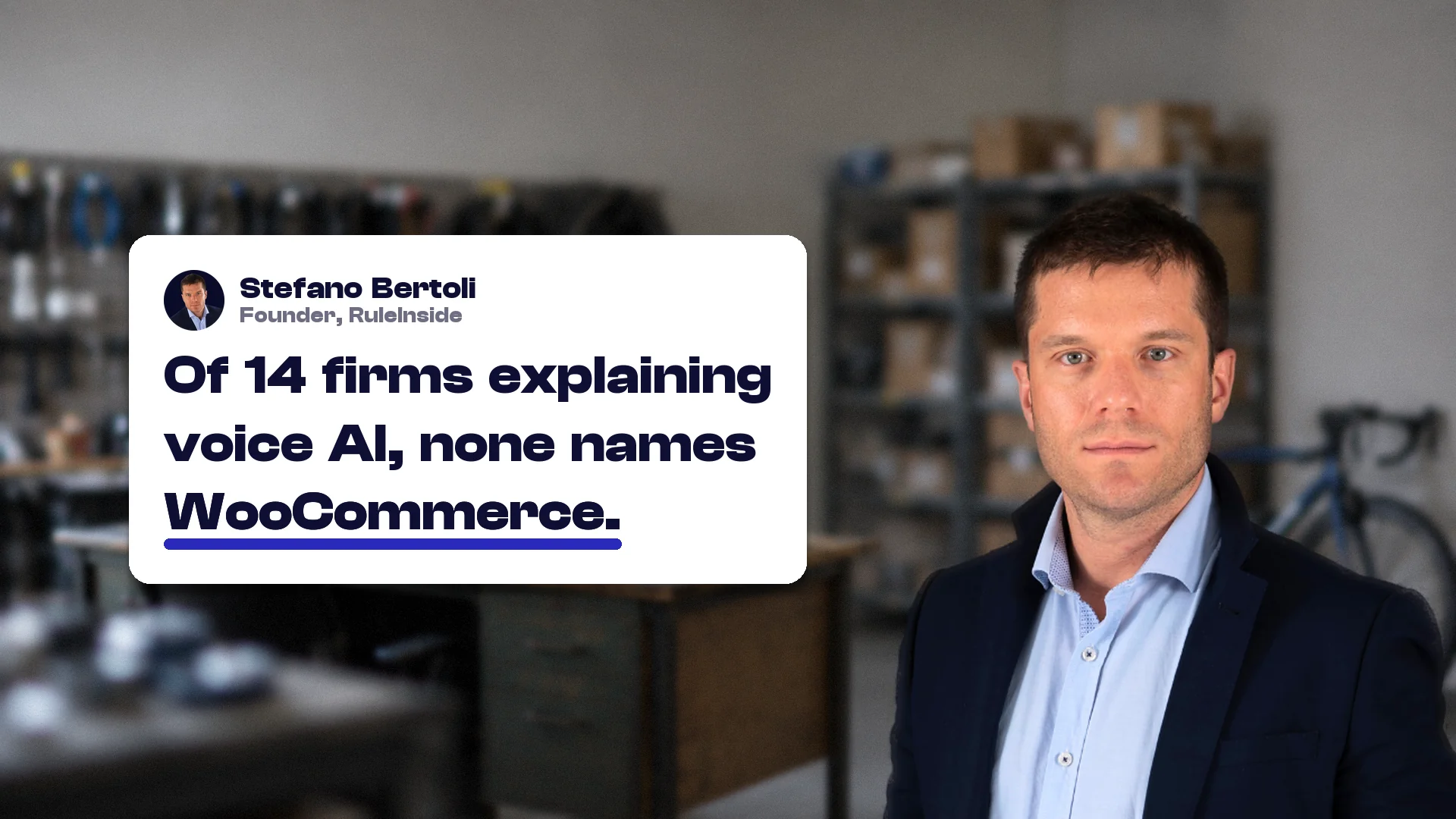
- Google’s first page for “what is voice AI” and “what is an AI voice agent” comes from 14 companies. All 14 sell voice AI or AI agents. Only 3 mention ecommerce or retail, and none names WooCommerce.
- The agent should say it is an AI and hand the caller to a person on request. It should never decide anything with money in it.
What is voice AI?
Voice AI is software that works with spoken language. It can hear speech, understand it, or produce a voice. The term covers several different tools, and Google’s search results mix them up.
- Voice changers and voice generators. They turn text, or your own voice, into a different voice. Creators use them for videos, games and voiceovers.
- Voice cloning. It copies one person’s voice from a recording of them.
- Voice assistants. Siri, Alexa and Google Assistant help whoever is using the phone or speaker.
- Speech recognition. It turns speech into text, as transcription and dictation tools do.
- AI voice agents. They hold a conversation for a business. They answer calls, look things up and reply out loud.
What people search for leans towards tools: text to voice, voice changers and generators. In Ubersuggest’s US data, read on 12 October 2026, “voice ai” gets about 18,100 searches a month. Next to it, “voice ai generator” and “voice ai voice changer” get about 1,600 each.
Google’s first page mixes the meanings too. I read the pages Google ranks first for “what is voice AI” and “what is an AI voice agent”. They come from 14 companies. Only 2 of them say outright that voice AI means more than one thing.
For a store owner, only the last tool on that list answers the phone. So when a store owner asks what voice AI is, this guide answers with the voice agent.
Why the meaning matters when you buy
A tool that makes voiceovers can sound excellent and still answer no calls. A voice agent needs your products, your orders and a way to reach a person. So when a vendor says “voice AI”, ask one question first: what does it do when a customer calls?
Bottom line: what is voice AI for an online store? It is an AI voice agent that talks with your customers.
What is an AI voice agent?
An AI voice agent is software that holds a spoken conversation for a business. It listens to the caller, works out what they want, looks it up and answers out loud. OpenAI’s developer guide puts it simply: voice agents “let users ask questions and complete tasks by speaking with your application”.[2]
If a missed call is what made you ask what voice AI is, this is the tool to read about. The caller speaks in their own words. There is no menu to learn and no button to press. The agent can answer on your phone line, or through a call button on your website.
How it differs from a phone menu
A phone menu asks callers to press 1 for orders and 2 for returns. It routes the call, and somebody still has to answer it. A voice agent understands a full sentence and answers it. A caller can simply ask where the parcel they ordered on Monday is.
How it differs from a voice assistant
Siri or Alexa works for the person who owns the phone or speaker. A voice agent works for your store. It reads your products, your orders and your policies, and it speaks to your customers.
How it differs from a chat agent
A voice agent does the same jobs as a chat agent: product questions, order status and returns. The difference is time. The caller is waiting on the line, and there is no screen to show a link. Our guide to AI agents for ecommerce covers those jobs one by one.
Bottom line: an AI voice agent answers your customers by voice, from your own store data, without a menu.
How does voice AI work on a phone call?
Every voice agent is built on one of three designs. As of October 2026, OpenAI’s developer guide describes them.[2] They differ in how the voice connects to the thinking.
| Design | How it works on a call |
|---|---|
| Three stages | Speech-to-text turns the caller’s words into text. The agent decides what to do and writes a reply. Text-to-speech reads that reply aloud |
| One voice model | OpenAI describes it as one model that will “interpret audio, decide what to do, and respond in speech” |
| Listen and speak | OpenAI’s GPT-Live “can listen and speak at the same time”, while a separate system does the lookups |
Whatever the design, the agent reaches your store through tools. A tool might be a product search, an order lookup or a transfer to your team. What the agent can do is the sum of the tools it is given.
What the agent needs from your store
A voice agent for a WooCommerce store reads your products, stock, orders and policies. One route is the WooCommerce REST API: you create a key in your store, and the agent uses it. Read access is enough to answer questions. Write access lets the agent change orders or products, so it needs a person checking. Our guide to AI agents for ecommerce walks through the key settings.
Why the design matters to a store
The three-stage design leaves text between each step. OpenAI names the advantage: you can “inspect or transform intermediate text and replace each component independently”.
For a store, that text is a written record of every call. OpenAI’s example is to “store the transcript, run policy checks before the text agent responds”, and only then speak the reply. A check before the answer is spoken is one way to catch a refund promise.
Bottom line: ask any vendor which design it uses, and whether you get a written transcript of every call.
Why does speed decide whether a call feels natural?
People take turns in conversation with very short gaps. A 2009 study timed answers to questions in 10 languages, from Danish to Japanese. The average gap between one person finishing and the other answering was 208 milliseconds.[3] Danish speakers were the slowest, at 469 milliseconds on average, and Japanese speakers the fastest, at 7 milliseconds.
The researchers summed it up: answers “tend to be neither in overlap nor delayed by more than a half-second”. That study timed people talking to people, face to face. It did not test machines.
My reading is that a voice agent has to look things up inside that rhythm. A long silence on a phone line sounds like a dropped call, even when the answer is right.
Fillers are not answers
An agent may say “let me check that” while it searches. OpenAI’s guide tells builders to measure such acknowledgments “separately from the answer the caller needs”. A quick filler followed by a long wait is still a long wait.
Interruptions
Callers interrupt, and a good agent stops talking and listens. On our demo store, the call widget shows “Talk to interrupt” while the agent is speaking. When I started a call there from a browser, it connected in about 4 seconds, and the agent spoke first.
Bottom line: test a voice agent by interrupting it, and by asking something it must look up.
What can a voice agent do for an online store?
On a store’s phone, a voice agent answers product and order questions, takes return requests and passes the call to a person. Your customers still call. A YouGov survey found that “Nearly 70% of Americans tend to use phone support, yet only 35% prefer it”. Only 1% prefer chatbots.[4]
Each job is one your team does today:
- It answers product questions from your live catalogue: what suits, what fits, what is in stock.
- It reads back an order’s status and tracking number, from the order itself.
- It takes a return request with the reason, for you to approve or decline.
- It passes the call to a person when the caller asks, or when it cannot help.
Worked example: one call to a skincare store
- The caller asks
- Whether the barrier repair moisturiser is in stock, and whether it suits dry skin
- The agent looks up
- The product, its stock level and its description, in the live catalogue
- The agent answers
- It names the product, says whether it is in stock, and asks if the caller wants anything else
An illustration built on our demo store’s catalogue, not a recorded call.
Each job needs live data. An agent working from a copy made on launch day can offer products that have sold out. Our page on the AI voice agent that answers your store’s phone shows what ours reads on a call.
Answering calls and making them are different jobs
Some agents also call customers, for example after an abandoned checkout. In the US, that usually needs consent first. In 2024 the FCC ruled that “callers must obtain prior express consent from the called party” before an AI voice call.[5] That ruling is about calls a business makes, not calls it answers.
Bottom line: what is voice AI worth to a store? It earns its place on the questions your phone already gets.
What do store owners say about phone calls?
I read 229 Reddit posts and comments about store phone calls and voice agents, in r/shopify, r/ecommerce and r/woocommerce. Then I checked who wrote each useful one. Seventeen came from 13 people I could confirm run or work for a store.
Their customers do call. Eight of the 13, all owners, say people phone their store. One gets calls asking for tracking “even though the customer is looking at the email”.[6] A clothing seller says callers ask “about the fit, the pockets and so on”.[7]
“Had the customer not have rang up & eventually paid with PayPal, that £1205 order would’ve been lost for good.”
Answering is the hard part. One owner has a full-time job that “doesn’t let me answer all calls coming from my website customers”.[9] Another owner is against phone support: “Cost outweighs benefit.”[10]
They are wary of AI on the line. A seller of high-ticket items says 10 to 20% of the people who get in touch “may actually be good leads”. They wrote: “Don’t want to scare away the 10-20% with AI”.[11] A shop’s staff member put it bluntly: older callers “want a real person”.[12]
Not one owner in what I read says an AI answers their calls today. Every post saying an AI answers their calls well came from a vendor’s account. Most were one cluster of accounts praising the same product. So the useful evidence is what owners say about the problem, not what accounts say about a product.
Bottom line: customers still phone small stores, and owners want a person within reach when they do.
What does Google's first page leave out for a store owner?
I read the 16 pages on Google’s first page for “what is voice AI” and “what is an AI voice agent”. They come from 14 companies. All 14 sell voice AI or AI agent products, so every explainer on Google’s first page comes from a seller.
Our count, made with code on the pages as they stood on 12 October 2026. Every match was checked by hand. Rankings from Ubersuggest’s US data.
The phone gets plenty of space: 13 of the 14 describe agents that answer calls. The store gets very little. Only 3 mention ecommerce or retail at all, in two sentences or fewer. Of the 14 firms explaining voice AI, none names WooCommerce, Shopify or WordPress.
The rules get little space too. Four of the 14 say callers should know they are talking to an AI. One mentions the FCC’s consent rules, and none names a US state law on AI calls.
Four different speed targets
Eleven of the 14 mention speed, and their targets disagree. Twilio says the whole pipeline needs to finish “in under 300ms”.[13] Phenom says under 500 milliseconds.[14] Retell says its agents “reply in around 600ms”.[15] AssemblyAI puts the round trip “around one second”.[16] Each of the four sells voice AI products.
Bottom line: Google’s first page explains the technology and skips the store, so this guide covers what it leaves out.
Where does voice AI go wrong?
Any honest account of what voice AI is includes where it goes wrong. It fails in a few predictable places. Twelve of the 14 companies on Google’s first page admit at least one limit, and seven mention accents or background noise.
- It mishears. Speech-to-text can get a name, a number or a product wrong, more so on a noisy line. AssemblyAI tells builders to “test on real accents, real background noise, and real messy speech.”[16]
- It answers wrongly. A wrong answer is still your answer. A Canadian tribunal told Air Canada it “is responsible for all the information on its website”, chatbot included.[17]
- It promises a date. An agent should give a delivery range you set, never a date it cannot keep.
- It decides about money. It can take a refund request and pass it on. A person should decide the refund, the discount or the exception.
- It works from old data. A changed policy or a sold-out product turns a right answer wrong overnight.
Two habits cover all five. Read the first calls yourself and fix the source of each wrong answer. And keep a clear handover to a person.
Bottom line: plan for the calls a voice agent gets wrong, not only the ones it gets right.
What happens when a caller asks for a person?
A voice agent should hand the caller to a person whenever they ask. It should also do it when it cannot help, without making the caller repeat everything.
Customer service leaders plan to keep people. In a March 2025 Gartner poll of 163 customer service leaders, 95% planned to retain human agents.[18]
I tested this on our demo store by text chat. First I asked whether I was talking to a real person. The agent said it was Velàri’s AI assistant, and offered to put me in touch with a person.
Then I asked to speak to a person. It asked for my name and the best phone number or email, so the team could follow up.
On a phone call, ours transfers the caller live to your phone or your team. Our AI voice agent page sets that out. If nobody picks up, the agent keeps the conversation and confirms the next step with the caller.
A good handover does three things:
- It reaches a person, now or with a clear time for a call back.
- It passes on what the caller already said.
- It tells the caller what happens next.
Bottom line: ask every vendor to show you a real handover, and listen to what the caller hears.
Does a voice agent have to say it is an AI?
In some places it must, and it is good practice everywhere. The rules depend on where your customers live. I’m not a lawyer, so treat this as a map, not advice.
- The EU. Since 2 August 2026, AI systems that talk with people must tell them they are talking to an AI. The law says people must be “informed that they are interacting with an AI system”, unless that is obvious.[19] The duty falls on whoever builds the system.
- Utah. A business selling to consumers must disclose that a customer is talking to generative AI “if the individual asks”.[20] In high-risk conversations, people in licensed professions must say so at the start.
- California. Its bot law bans using an online bot to mislead people about “its artificial identity” to sell to them.[21] The text covers online bots and does not mention phone calls.
Recording the call
A voice agent may record or transcribe the call. In California, recording a confidential call needs “the consent of all parties”.[22] Our demo agent shows a recording notice before the call starts. In its text chat, it introduces itself as “an AI assistant for Velàri Skincare” and says “this call may be recorded”.
What the first sentence should say
Put three facts in the agent’s first sentence. Say who it speaks for, that it is an AI, and that the call may be recorded. Then get to the caller’s question. Offer a person at any point in the call.
Bottom line: make the agent say it is an AI, and that the call may be recorded, in its first sentence.
How do you test voice AI before your store uses it?
Reading about what voice AI is only takes you so far, and a demo recording proves little. Test the agent yourself, on the questions your store really gets.
Ask a real question. Take one from last month’s emails, in the customer’s own words.
Ask for a lookup. Give an order number and ask where the parcel is.
Interrupt it. Cut in mid-sentence, and check that it stops and listens.
Ask if it is a person. It should say plainly that it is an AI.
Ask for a person. Note what it does, and how long it takes.
Ask for a refund. It should take the request, not decide it.
Ask for the transcript. You should be able to read every call afterwards.
Ask where recordings are kept. Ask who can read them, and for how long.
Then ask the vendor three questions in writing. What can the agent change in your store? Who reads the calls after launch? And what happens when it gets something wrong?
You can run most of this list on our demo store today. It is a skincare shop we built to show the agent working.
Bottom line: judge a voice agent on your own questions, including the ones it should not answer.

Try it free · your next step
Call an AI Voice Agent on a Real WooCommerce Store
The quickest way to learn what voice AI is: hear a voice agent. Velàri Skincare is our demo store. Its agent answers from the store’s own products and policies, by voice or by text.
- Start a call from your browser, and ask what suits dry skin.
- Try interrupting it while it talks.
- Ask whether you are talking to a person.
- Ask for a person, and see what it does next.
It is our own demo shop, not a client's store. It asks you to accept recording before the conversation starts.
Try the Demo StoreQuestions Store Owners Ask About Voice AI
Voice AI is used to hear, understand or produce speech. People use it for voiceovers, voice changers, dictation, voice assistants and phone calls.
For an online store, the main use is answering customers by voice, from live store data. The agent answers product and order questions, takes return requests and passes calls to a person.
An AI voice assistant helps one person on their own device. Siri, Alexa and Google Assistant are voice assistants.
A store’s voice agent is a different tool. It works for your business, answers your customers and reads your products and orders.
An AI voice agent listens, decides and speaks. In the three-stage design, speech-to-text writes down the caller’s words, the agent decides the reply, and text-to-speech says it.
Other designs use a single voice model that hears the caller and speaks the reply. In every design, the agent reaches your store through tools, such as a product search or an order lookup.
Voice-to-voice AI, also called speech-to-speech, uses one model both to hear the caller and to speak the reply. OpenAI describes it as one model that will “interpret audio, decide what to do, and respond in speech”.[2]
The same phrase also names tools that turn one voice into another, like voice changers. Check which one a page means.
TTS means text-to-speech. It turns written text into a spoken voice.
In a three-stage voice agent, TTS is the last step: it reads the agent’s reply aloud. It is the voice the caller hears, so listen to it before you choose.
Latency is the wait between the caller finishing and the agent starting to answer. Between people, a study of 10 languages measured an average gap of 208 milliseconds.[3]
OpenAI tells builders to “measure how long callers wait for a useful spoken answer”. A filler such as “let me check” does not count as the answer.[2]
Voice AI can be trusted with questions it answers from your own data, if someone checks its calls. It should not be trusted to decide refunds, discounts or exceptions.
Its answers are your answers. A Canadian tribunal held Air Canada responsible for what its website chatbot told a customer.[17] A transcript of every call lets you check what your agent said.
An AI voice agent is usually billed by the minute of call time. That minute is built from several parts, and the phone line is a separate bill.
Add the build and the hours it takes to run it. Our guide to AI agents for ecommerce shows how a voice minute is built.
AI voice agents can take the repeat calls: order status, stock and returns questions. People stay for the hard calls and the decisions.
In a 2025 Gartner poll of 163 customer service leaders, 95% planned to retain human agents.[18] For a small store, the change is a phone that gets answered when nobody can pick up.
The laws in this guide regulate how an AI voice is used. They do not ban a store from answering calls with one.
In Utah, say it is an AI if the customer asks. In the EU, the system must tell people it is an AI. In the US, AI calls that a business makes usually need consent first. California needs every party’s consent to record a confidential call.

How I wrote this guide
Who wrote it. I did. I run RuleInside, which builds AI voice agents for WordPress stores, so I sell what this guide describes.
The top-ranking pages. I read the 16 pages Google ranks first for “what is voice AI” and “what is an AI voice agent”. I read them on 12 October 2026. Ubersuggest recorded those rankings in September. I used code to count what each page covers, then checked by hand every match the code found.
The demo store. On 12 October 2026 I asked our demo store’s agent two questions by text chat. I also started a voice call from a browser and timed the connection from the screen.
Owners. I read 229 Reddit posts and comments on store phone calls and voice agents, posted from 2024 to 2026. I checked each useful author’s other posts, and quote as owners only those I could confirm. One quote is from a shop’s staff member, and the guide says so. Reddit’s archive search failed for most of my queries that day, so the read is not complete.
Sources. Laws come from their official texts. Where a figure comes from a company that sells voice AI, the guide says so.
Updates. I revise this guide when a source changes. The date at the top shows the last real update.
Sources
- Voice.ai, “Free AI Voice Changer & Voice Agent Platform”, read 12 October 2026. The first result for “what is voice AI” in Ubersuggest’s US read of the same day. Read the source
- OpenAI, “Voice agents”, OpenAI API documentation, read 12 October 2026. OpenAI sells voice models. Read the source
- Stivers and colleagues, “Universals and cultural variation in turn-taking in conversation”, PNAS 106(26), June 2009. Read the source
- YouGov, “How Americans prefer to contact businesses for customer service”, 13 March 2025. Read the source
- Federal Communications Commission, Declaratory Ruling FCC 24-17, adopted 2 February 2024, released 8 February 2024. Read the source
- A post on r/shopify about the shipment email and the order status page, 15 October 2025. Read the source
- A reply in “Anyone using phone support (AI or real people) for their store?”, r/shopify, 15 January 2026. Read the source
- A post on r/shopify, “Shop Pay causing more issues than it solves?”, 21 May 2026. Read the source
- A post on r/shopify, “Can Shopify help with phone forwarding?”, 25 July 2026. Read the source
- A reply in “Anyone using phone support (AI or real people) for their store?”, r/shopify, 14 January 2026. Read the source
- A reply in “Anyone using phone support (AI or real people) for their store?”, r/shopify, 17 January 2026. Read the source
- A reply in “Payment options for 60+ folks”, r/woocommerce, 14 March 2026. Read the source
- Twilio, “What is voice AI and how does it work in 2026?”, 12 June 2026. Twilio sells communications software and voice AI infrastructure. Read the source
- Phenom, “AI Voice Agents: Everything You Recruiters Need to Know (2026 Guide)”, 5 May 2026. Phenom sells recruiting software, including a voice screening agent. Read the source
- Retell AI, “What Is an AI Voice Agent? A Simple Guide for 2026”, 28 July 2026. Retell sells a voice agent platform. Read the source
- AssemblyAI, “AI voice agents: what they are and how they work in 2026”, 30 September 2026. AssemblyAI sells speech-to-text and a voice agent API. Read the source
- British Columbia Civil Resolution Tribunal, Moffatt v. Air Canada, 2024 BCCRT 149, 14 February 2024. Read the source
- Gartner, “Gartner Predicts 50% of Organizations Will Abandon Plans to Reduce Customer Service Workforce Due to AI”, 10 June 2025. Read the source
- Regulation (EU) 2024/1689 (the AI Act), Article 50(1) and Article 113, Official Journal of the European Union, 12 July 2024. Read the source
- Utah Code 13-77-103, “Required disclosures”, effective 7 May 2025. Read the source
- California Business and Professions Code, sections 17940 to 17943, “Bots”. Read the source
- California Penal Code, section 632. Read the source
On this page