

A customer rings your store and hears: press 1 for orders, press 2 for everything else. Both options ring the same phone: yours.
That menu is an IVR. You may be looking up what IVR is because the phone has started eating into your day. The real question is who should take the call.
I’m Stefano Bertoli, founder of RuleInside, and I build AI voice agents for WordPress stores. So I sell one alternative to a menu, and I say where a menu is the better choice.
For this guide I read the pages that rank highest in the US for what is ivr. I priced four phone systems and read what store owners say about menus.
I also tested our own demo store’s agent on the calls a menu routes.
Key takeaways
- What is IVR? Interactive voice response is an automated phone system. It plays options, takes key presses or spoken answers, and routes the call.
- A basic menu sorts calls but does not answer them. In a store run by one or two people, every option can ring the same phone.
- Plans with a menu cost $15 to $27 per user a month in the four systems I priced, mostly billed yearly.
- Callers want a person within reach. Keep a menu short, or let an AI voice agent answer the caller’s question and pass the call on.
What Is IVR?
IVR stands for interactive voice response. It is the automated system that answers a business call and offers the caller options. TechTarget, a technology publisher, describes a system that “interacts with callers, gathers information and routes calls to the appropriate recipients”.[1]
USAGov, the US government’s information service, puts it in one line. An IVR “routes callers on a phone tree, based on their voice responses or pressing a specific button”.[2]
You will also hear it called a phone menu, a phone tree or an auto attendant. Most people use the names loosely. The section on auto attendants below shows where they differ.
IVR meaning: the phone system, not the other meanings
Search for ivr and Google’s suggestions add other meanings: a heart rhythm, a stock ticker and a measure used in options trading. One of the pages that rank for what is ivr is a stock page for the ticker IVR. This guide means the phone system only.
Who IVR guides are written for
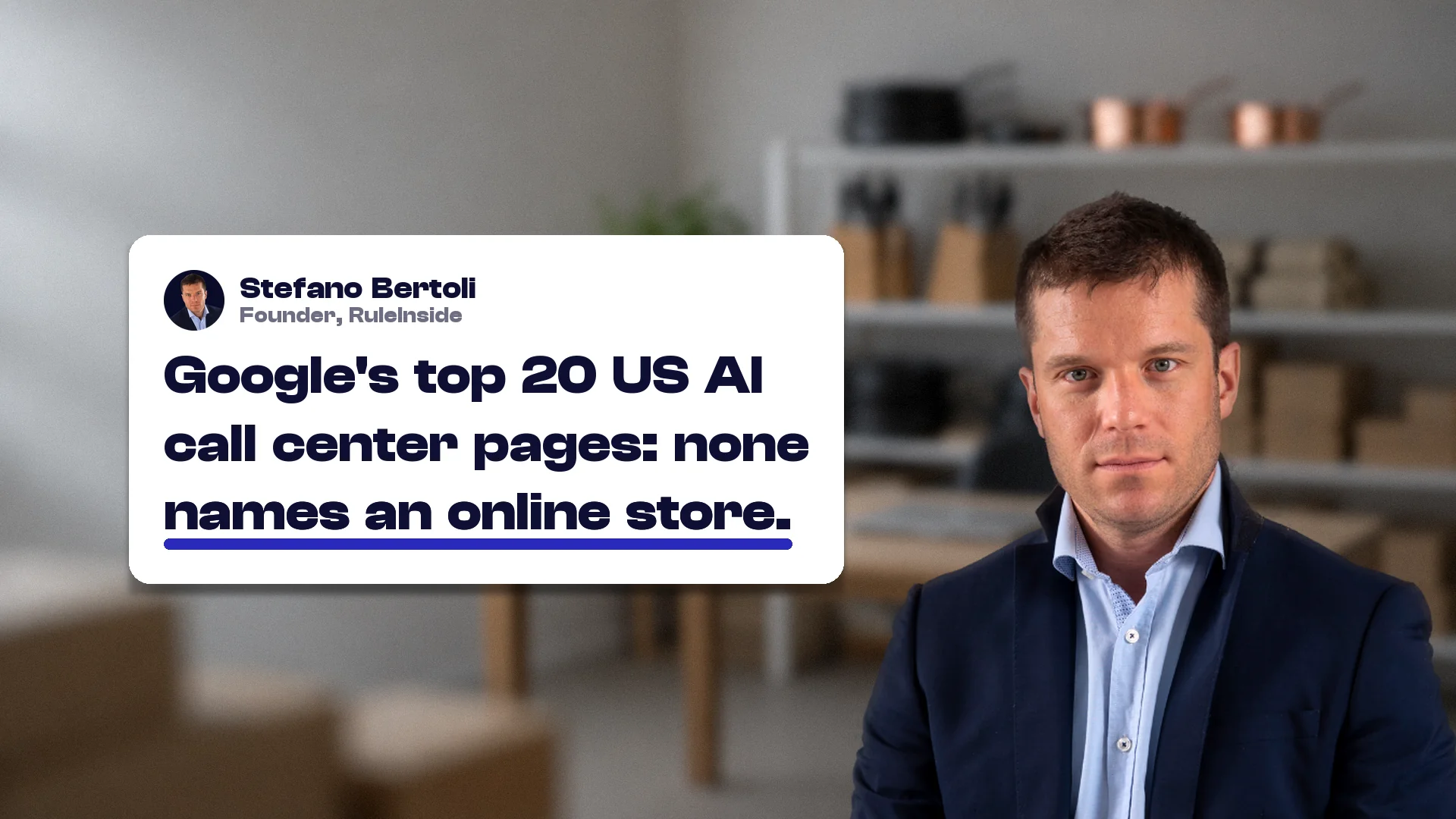
The pages that explain IVR are written for contact centres. I read the 19 pages on IVR among the top 20 US results for what is ivr. All 19 describe calls going on to a department or an agent. Fourteen use healthcare as an example, and 12 use banking or finance.
Eighteen of the 19 come from companies that sell something, and 15 sell phone or contact centre products. The remaining page is GetVoIP, a site that reviews phone systems. None names WooCommerce or another store platform. The five that mention ecommerce list it as one item among many.
Bottom line: an IVR is the automated menu that answers a call and sends it somewhere.
How Does an IVR Work on a Call?
An IVR handles a call in up to four steps: a greeting, a choice, sometimes a lookup, then a transfer. Amazon’s documentation for its contact centre software gives the classic menu: “Press 1 for Sales, press 2 for Support.”[3]
| Step | What happens | On a store’s line |
|---|---|---|
| Greeting | A recorded or computer voice reads the options | Thanks for calling. Press 1 for orders. |
| Choice | The caller presses a key or says a word | The caller presses 1 |
| Lookup | Some systems read a database first | Only if someone connects the system to your store |
| Transfer | The call goes to a person, a queue, another menu or voicemail | Your phone rings |
The greeting can be your own recording or a computer voice. Microsoft’s admin guide says prompts “can be created by using text-to-speech (system-generated prompts) or by uploading a recorded audio file”.[4] The same guide says callers can speak or use the keypad.
The lookup step is where an IVR can do more than route. IBM, which sells contact centre software, covers the case where the lookup fails. Then, it says, “the programmed menu options can assist with call routing”.[5]
Why the lookup step matters to a store
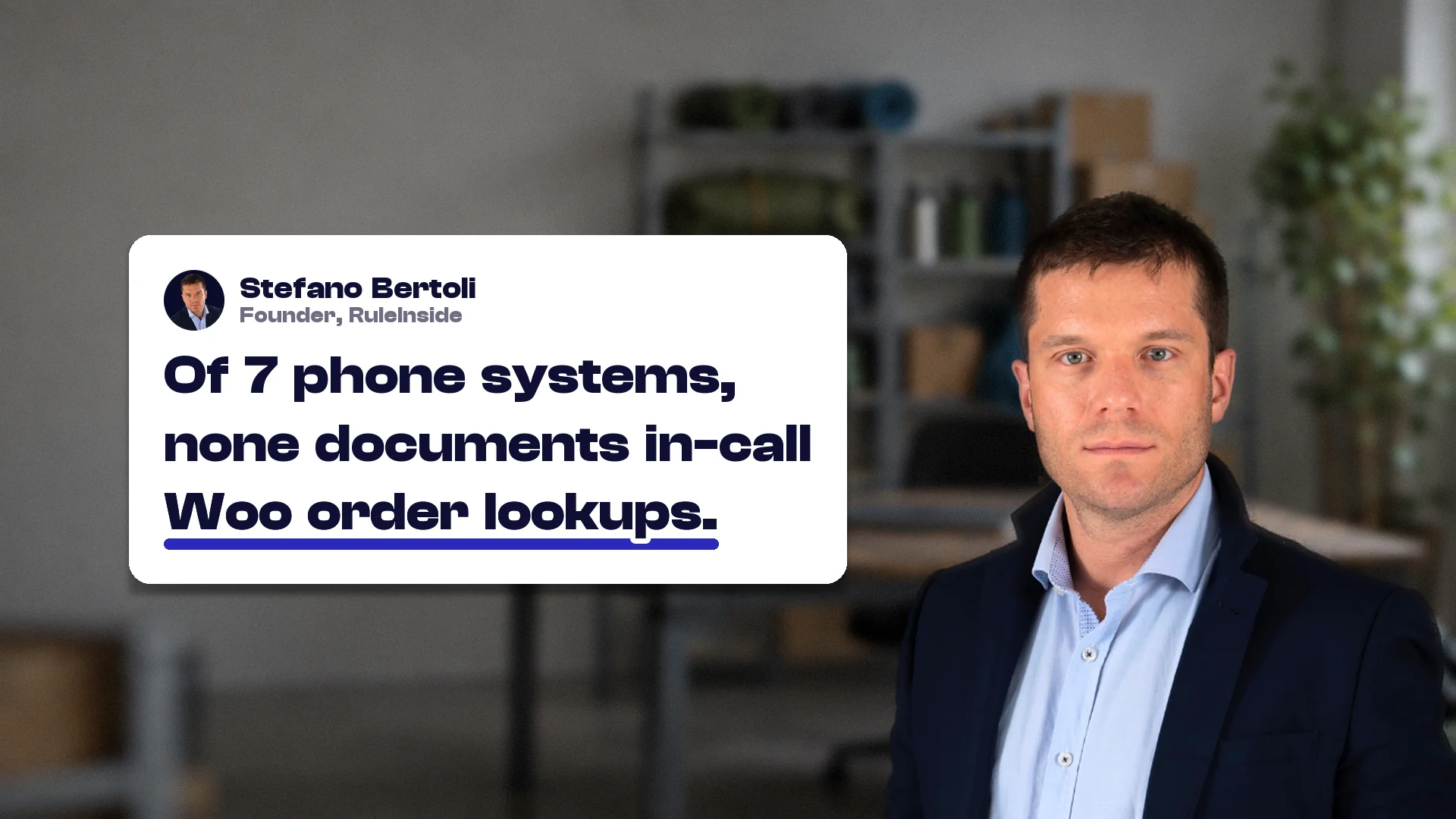
A menu can tell callers your opening hours without any store data. To read an order, someone has to connect the menu to your store. In our comparison of automated phone systems, none of the seven documented a WooCommerce order lookup during a call.
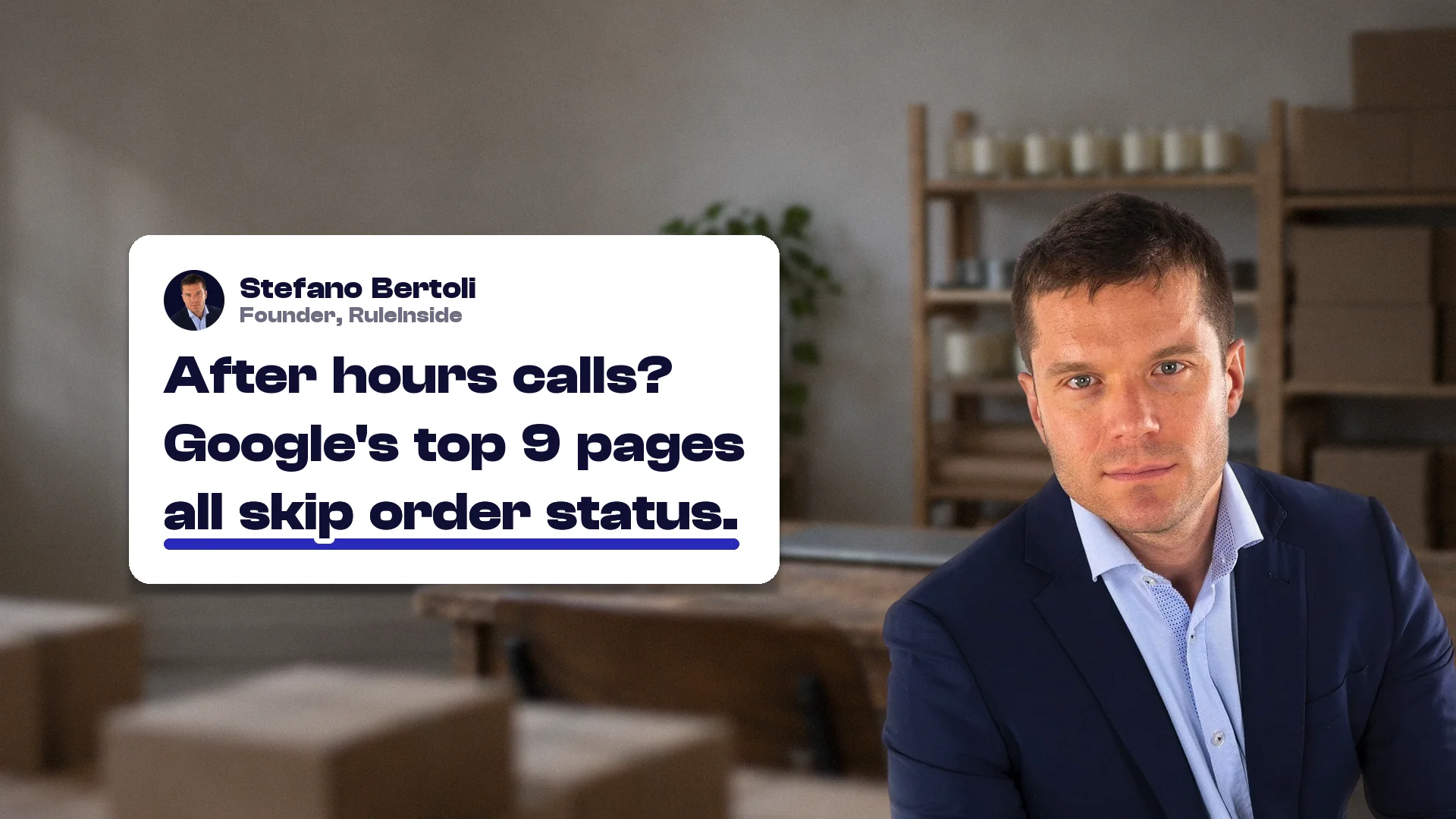
The pages that explain IVR skip this step for stores. Of the 19 I read, 10 list order status as a use, mostly as one item in a list. One links order status to an order management system, but does not name one.
Bottom line: an IVR routes the call, and reads your orders only if someone connects it to your store.
Where Did Press-1 Phone Menus Come From?
Phone menus rest on touch-tone dialling, which arrived in 1963. The IEEE History Center’s wiki says Touch-Tone service began “in the fall of 1963 in Greensburg and Carnegie, Pennsylvania”.[6] It cost an extra $1.50 a month at the time.
Each key sends two tones at once: one for its row and one for its column. The wiki says the tones sit “within the frequency range of the human voice”. So they travel down the line during a call. That is what lets a computer hear which key you pressed.
The international standard for those tones, ITU-T Recommendation Q.23, is still in force. It fixes eight frequencies, from 697 to 1,633 hertz.[7] The star and hash keys came in 1968. AT&T began “adding the * and # keys for just the advanced services for which they are used today”.[6]
When computers started answering
IVR took longer than the keypad. TechTarget says the technology “wasn’t cost-effective for wide commercial deployment until the mid-1980s”, when hard drive storage fell in price.[1] IBM names Moviefone as one of the best-known IVR services of the 1990s. Callers gave their postcode and heard the nearby cinemas and their films.[5]
Bottom line: the press-1 menu runs on a 1960s keypad signal, and it became affordable for businesses in the mid-1980s.
What Are the Types of IVR?
The common way to sort IVR is by how the caller answers. IBM names three kinds, each with its own example.[5]
| Type | How the caller answers | IBM’s example prompt |
|---|---|---|
| Touch-tone | Presses a key | “Press one for store hour information” |
| Directed dialogue | Says one of the options offered | “Are you looking for store hours or location information?” |
| Natural language | Says what they want in their own words | “what information are you looking for today?” |
The top pages for what is ivr do not agree on the types. Seven of the 19 list them, and their lists run from 3 types to 15. Most of the seven sort by how callers answer. One sorts by where the software runs, on your premises or in the cloud, and another mixes both.
Conversational IVR
Conversational IVR is the natural language kind, with replies in full sentences. TechTarget says natural language processing “enables IVR to deliver a conversational response to callers”.[1]
On the pages I read, it is sold as an upgrade to the menu. Eleven of the 19 say callers can state their request in their own words. Unless the system can answer the request, the call then goes on to a department or an agent. The section below on what replaces an IVR covers an agent that answers the request itself.
Bottom line: the type of IVR tells you how callers answer it, not whether anyone answers their question.
IVR vs Auto Attendant: What Is the Difference?
An auto attendant routes calls, while an IVR can also collect information and complete a task. Telebroad sells business phone systems. It calls an auto attendant “a particular simplified application of IVR technology with the function of a virtual receptionist”.[8]
Nextiva, which sells phone systems, draws the same line on its blog. There, an IVR “routes calls, collects information, authenticates callers, retrieves data from connected business systems, and completes tasks”.[9]
Microsoft’s admin guide gives an auto attendant’s job: “to direct a caller to an appropriate person or department”.[4] Another Nextiva page names its limit: “An auto attendant can’t answer questions or take a message beyond a generic voicemail.”[10]
In small-business phone plans, the names blur
Some plans list one feature under both names. RingCentral’s plan comparison table lists “Multi-level auto attendant and IVR”.[11] Nextiva, by contrast, lists its simple IVR and a dial-by-name auto attendant as separate features.[12] Only 2 of the 19 pages that rank for what is ivr compare the two terms.
So when a plan says auto attendant or IVR, ask one question. Does the menu only route the call, or can it read your data?
Bottom line: an auto attendant is the routing kind of IVR, so ask what else a plan’s menu can do.
What Does an IVR Cost a Small Business?
For a small store, an IVR comes as a feature of a business phone plan, priced per user each month. Only one of the 19 pages that rank highest in the US for what is ivr gives a price.
So I read four vendors’ own pricing pages on 26 October 2026, from Europe. The prices are in US dollars, as listed. Each row is the cheapest plan that includes a menu.
| System | Plan | Per user a month | What the vendor says about the menu |
|---|---|---|---|
| Nextiva | NEXT Core | $15 on a 12-month term, $23 month to month | “Simple IVR”. The page does not say whether menus can lead to more menus[12] |
| RingCentral | Core | $20 billed yearly, $30 monthly | “Multi-level auto attendant and IVR”[11] |
| Google Voice | Standard | $20, added to a Google Workspace plan | A menu can lead callers to a submenu[13][14] |
| Quo | Business | $27 billed yearly, $33 monthly | Up to 10 options a menu, and menus can lead to more menus[15][16] |
Two of the four need a note. Google sells Voice on top of a Workspace plan, and that plan costs extra. Lower on Quo’s pricing page, its comparison table lists Business at $23, not the $27 on its plan cards.
Two other phone systems are left out: Grasshopper, whose pricing page did not load its plans for me, and Dialpad, whose menu feature I did not check.
What the one page with a price says
The one page with a price is from GetVoIP, a site that reviews phone systems. It puts contact centre systems with IVR at “$20.00/user per month to $150.00+/user per month”.[17] Store owners can pay less. One, a manufacturer selling on Amazon and Shopify, built a two-option menu on a $3-a-month phone service.[18]
The per-user price matters. A store with three people taking calls pays three times the listed price.
Bottom line: a menu costs $15 to $27 per user a month in the four plans I priced, mostly billed yearly.
What Do Callers Think of Phone Menus?
Callers put up with menus, and most would rather reach a person. The newest surveys I found that ask about menus are from 2019. One of them was paid for by a company that sells phone systems.
51%
of 2,010 people in the US said they had left a business after reaching its phone menu.[20]
Vonage, 2019
Clutch is a ratings firm for business services. Vonage sells phone systems, and Opinion Matters ran its survey. In Clutch’s survey, the top frustrations were irrelevant options (69%) and not being able to describe the problem (67%).
An older study, published in 2016, points the same way. Boston University researchers surveyed 1,321 online respondents matched to the US population. On phone menus, the researchers report: “Only 10 percent were satisfied with their experience”.[21] The authors name its funder as the industry group Interactions.
A newer survey asks about AI, not menus
The newest survey I found asks about AI in customer service, not menus. Gartner surveyed 3,566 customers in February and March 2026. Of them, 87% said a company using generative AI must offer a way to reach a human agent.[22]
Store owners meet the same problem when they are the caller. Of 12 owners who wrote about calling a company, 8 described trouble reaching a person. Seven of those were calling Shopify. One wrote that Shopify “took away the possibility of speaking to a human on the phone”.[23]
Bottom line: callers accept a menu that leads to a person, and some leave a business whose menu does not.
Does an Online Store Need an IVR?
A menu routes calls, so it helps a store only when there is somewhere to route them. A menu earns its place when different people take different calls. In a store run by one or two people, every option can ring the same phone.
Customers still call online stores. Gorgias, which sells a help desk to online stores, compared the same 10,990 brands in early 2024 and early 2026. Requests that began with a phone call rose 20%.[24]
What store owners use a menu for
I read what store owners on Reddit say about their own phone line. Of the 15 who described it, 6 run a menu or an automated line today.
Three say it keeps robocalls away. One owner’s menu sends each caller to the owner’s phone or a staff member’s, depending on the question. One plays a recorded answer, and one tells callers where their parcel is.
“Both options go to the same phone number”
That owner, the manufacturer from the price section, set the menu up to stop spam calls: “The bots give up”.[25] A recorded answer has limits, though. Another owner recorded a message on the menu saying their stock was live, and “people still come through to ask”.[26]
The owner whose menu rings different phones by question stresses one detail: “it’s not a robotic voice that answers, but my own”.[27] GetVoIP agrees a small company may not need much: “a simple solution with greetings, menus and call routing will do”.[17]
A menu fits when
- Different people take different kinds of call.
- Robocalls flood your line.
- Callers need a voicemail when nobody is free.
A menu fits badly when
- One person takes every call.
- Callers ring about their order, and nobody has connected the menu to your orders.
- Your callers want a person straight away.
Bottom line: a store needs a menu when it has different people to send callers to, or a spam problem.
How Do You Set Up a Phone Menu Callers Don't Hate?
Keep the menu short, put the common reasons first and always offer a person. The clearest rules come from two US public bodies.
New Jersey’s Office of Innovation based its guide on user testing and on advice from contact centre staff across the state. One rule reads: “Limit each menu to 5 options if possible”.[28] Nine options, it says, can take up to a minute to hear.
It also warns against nested menus. When menus get complicated, callers hunt for the fastest way to a person, “often resorting to spamming zero”. Its advice is to try self-service once: “After a self-serve attempt, direct users to an agent.”
USAGov did the same after more than 430,000 calls in 2019: “We limited the main menu to five topics”.[2] It put the most popular topics first.
Clutch’s advice is plain: “Businesses should always include an option to speak to a live agent in their phone menu.”[19]
Five options or fewer. Fewer is better on a small store’s line.
The common reason first. If most callers ask about an order, make that option 1.
A way to a person. Say it in the menu, not only after a wrong turn.
An option for everything else. New Jersey’s guide asks for one.
A key to repeat the options. New Jersey’s example uses the star key.
One level if you can. Each extra menu is another place to hang up.
Your own voice. One store owner records the greeting themselves.
A test call. Ring your own number and time how long the menu takes.
Bottom line: a short menu with a person one key away is the menu callers tolerate best.
What Replaces an IVR for a Small Store?
An AI voice agent replaces the menu with a conversation. The caller says what they want, and the agent answers from your store data. Then it passes the call to a person when needed.
Phone system makers are moving the same way. Microsoft’s Teams Phone Agents “screen calls, answer questions, manage appointments, and route callers without fixed menus”.[4] Five of the 19 pages I read mention AI voice agents. Only one explains how an agent and an IVR fit together, and it says they work in tandem.
| Question | Phone menu | AI voice agent |
|---|---|---|
| The caller | Presses keys or says an option | Says what they want |
| The answer | A recording, or a person after the transfer | From your products, orders and policies, once connected |
| Order status | Only if someone builds the link | Reads the order when connected to your store |
| A person | Rings the phone the option points to | Passes the call on when asked |
Gartner expected big contact centres to go first. In 2022 it predicted early adoption of conversational AI would be “primarily led by organizations with 2,500 or more agents”.[29] A small store has no such team, which is why we configure and run our agent for you.
Our guide to what voice AI is explains how an agent hears and answers. Our AI voice agent answers your store’s phone and transfers callers live to your phone or your team. You keep your store’s number.
What an AI on your line should tell callers
None of the 19 IVR pages tells a business what callers should hear about automation or recording. Have the agent say in its first sentence that it is an AI, and that the call may be recorded. In 2024 the FCC, the US communications regulator, ruled that AI voices count as artificial voices on outgoing calls.[30] The ruling covers calls a business makes, not calls it answers. I’m not a lawyer, so check the rules where your customers live.
Bottom line: where a menu routes the caller, an AI voice agent answers them and keeps a person within reach.
What Did Our Demo Agent Do With the Calls a Menu Routes?
Our demo agent handled all four questions itself. It answered three, and offered a callback when I asked for a person. I tested our own demo store’s AI agent by text chat on 26 October 2026. Velàri Skincare is a demo shop we built, not a client’s store.
I asked about the four things people ring a store for: an order, stock, returns and a person. A press-1 menu would send each one somewhere. Here is what the agent did instead.
| Question | A press-1 menu | Our demo agent |
|---|---|---|
| Where is my order? | Sends it to whoever handles orders | Confirmed the order number, email and postcode with me. Then said the order was processing, named its two products and said it had no tracking number yet |
| Is it in stock? | Sends it to sales | Named a moisturiser for dry skin and said it was in stock |
| Returns | Plays a recording, or sends it on | Gave the 30-day window for unopened products, and said the team helps with a reaction or a fault |
| A person | Rings a phone, if one is free | Asked for a name and a phone number or email, to arrange a callback |
The order took two tries. The agent asks the caller to confirm the details before it looks up an order. In my first chat, my next question arrived before I had confirmed. In the second, I confirmed and it read the order back.
This was a text chat, not a phone call, because the chat widget shows no transcript in voice mode. On a phone call, our agent transfers the caller live to your phone, as our AI voice agent page explains.
Bottom line: the questions a menu can only route are the ones an agent connected to your store can answer.

Free demo · your next step
Hear an AI Agent Answer the Calls a Phone Menu Would Route
Before you set up a press-1 menu, hear an agent answer the calls instead. In a 20-minute demo, you watch our agent work on Velàri Skincare, our demo store.
- It answers a product question, looks up an order and greets a returning customer.
- You see the WooCommerce data behind every answer, and you can interrupt at any point.
- We tell you what we would deploy on your store, whether or not you buy.
The demo runs on our store, not a client's, so nothing connects to yours and there is nothing to prepare.
Book My Free 20-Minute DemoQuestions Store Owners Ask About IVR
IVR means interactive voice response. It is the automated system that answers a business call, offers options and routes the caller.
The same letters also name a heart rhythm and a stock ticker. On a business phone line, IVR always means the menu.
An IVR system is the software behind a phone menu. It plays the greeting, hears a key press or a spoken answer, and sends the call on.
A small business can get it as a feature of a business phone plan. In the four plans I priced, it costs $15 to $27 per user a month, mostly billed yearly.
In a call centre or contact centre, IVR is the front door. It greets every caller, answers simple requests from a database and sends the rest to the right queue of agents.
The pages that explain IVR are mostly written for contact centres. A small store has no queues or departments, so its menu does less. Our guide to AI call centres asks whether one can answer a small store’s phone.
An IVR plays recorded or computer-voiced options, listens for a key press or a word, and transfers the call. Some systems read a database first.
Each key on the phone sends two tones at once, which the system hears during the call. The current version of the international standard for those tones, ITU-T Q.23, dates from 1988.
A basic IVR is not AI. It follows a fixed menu that someone set up, and it reacts to keys or a few words.
Newer systems add speech recognition and natural language, so callers can speak freely. An AI voice agent goes further and answers the question from your data.
An auto attendant routes calls through a menu, while an IVR can also collect information and complete tasks. Phone vendors describe the auto attendant as the simpler kind of IVR.
Some small-business phone plans list one feature under both names. Ask whether the menu only routes, or can read your data.
For a small business, an IVR system usually comes inside a business phone plan, priced per user each month. In the four plans I priced on 26 October 2026, a menu cost $15 to $27 per user a month. Three of those prices are for yearly billing.
Monthly billing costs more, and Google Voice’s $20 comes on top of a Google Workspace plan. One store owner built a two-option menu on a $3-a-month phone service.
A small business needs an IVR only when different people take different calls, or when spam calls flood the line. Otherwise every option can ring the same phone.
Callers prefer a person: 88% of 501 US callers said so in a 2019 survey. If you add a menu, keep it to a few options and offer a person.
Conversational IVR lets callers say what they want in their own words, instead of pressing keys. It uses natural language processing to understand them and reply in sentences.
It still mostly routes the call to a department or an agent. An AI voice agent connected to your store can answer the question itself.
IVR has no single invention date. Touch-tone dialling, which phone menus rely on, began in Pennsylvania in the autumn of 1963.
TechTarget, a technology publisher, says IVR became affordable for wide commercial use in the mid-1980s, when hard drive storage fell in price.

How I wrote this guide
Who wrote it. I did. I run RuleInside, which builds and runs AI voice agents for WordPress stores. So I sell one alternative to a phone menu.
The top-ranking pages. I read the top 20 organic results in the US for what is ivr on 26 October 2026. Ubersuggest, a keyword research tool, recorded that ranking on 18 October 2026. One, a stock ticker page, blocked automated reading and is off topic, so it is not counted, which leaves 19. Two pages had expired or incomplete security certificates, so I read their public text without checking the certificate. One blocked automated requests, so I read it in an ordinary browser window. I used code to count what each page covers, then checked every result by hand.
Owners. I read Reddit posts and replies about phone menus and answering the store phone. They come from a local copy of r/shopify, r/ecommerce and r/woocommerce from January 2024, and r/smallbusiness from October 2025. Where a post did not show whether its author runs a store, I read the author’s other posts. I quote as store owners only those I could confirm.
Sources. I read every source on 26 October 2026, except the FCC ruling, read on 24 October 2026. RingCentral then moved its pricing page. I read the new address on 31 October 2026, and the plan and prices had not changed. New Jersey’s guide is no longer at its own address, so I cite the Internet Archive’s copy. Prices were read from Europe and shown in US dollars.
The demo store. On 26 October 2026 I sent our demo store’s agent its questions in two text chats, through an automated test. This guide reports what it answered.
AI help. I used AI to gather and check the sources and to write the first draft. Every figure is checked against its source.
Updates. I revise this guide when the facts change. The date at the top shows the last real update.
Sources
- TechTarget, “What is Interactive Voice Response (IVR)?”, by Scott Robinson and Karolina Kiwak, published 4 February 2025. Read the source
- USAGov, “Press or Say 1: USAGov Expands Its Use of Interactive Voice Response”, 24 March 2020. Read the source
- Amazon Web Services, “Flow block in Connect Customer: Get customer input”, Amazon Connect administrator guide, read 26 October 2026. AWS sells Amazon Connect. Read the source
- Microsoft Learn, “Overview of voice applications”, Microsoft Teams documentation, updated 31 August 2026. Microsoft sells Teams Phone. Read the source
- IBM, “What Is Interactive Voice Response (IVR)?”, IBM Think, updated 17 November 2025. IBM sells contact centre and AI software. Read the source
- Engineering and Technology History Wiki (IEEE History Center), “Telephone Dials”, read 26 October 2026. Read the source
- ITU-T, Recommendation Q.23, “Technical features of push-button telephone sets”, approved 25 November 1988, in force. Read the source
- Telebroad, “What Is an Auto-Attendant and How Is It Different From IVR?”, Telebroad support centre, read 26 October 2026. Telebroad sells business phone systems. Read the source
- Nextiva, “IVR vs Auto Attendant: Differences & AI’s Role”, by Jack Kosakowski, 31 May 2026. Nextiva sells phone systems and an AI receptionist. Read the source
- Nextiva, “What Type of After-Hours Answering Service Should You Pick?”, read 26 October 2026. Read the source
- RingCentral, “RingCentral AI Communications Platform Plans & Pricing”, read 31 October 2026. Read the source
- Nextiva, “Plans & Pricing”, read 26 October 2026. Read the source
- Google Workspace, “Google Voice: Business Phone Number & Systems”, read 26 October 2026. Read the source
- Google Workspace Admin Help, “Set up a Voice automated attendant for your organization”, updated 22 October 2026. Read the source
- Quo, “Quo Pricing”, read 26 October 2026. Quo was formerly OpenPhone. Read the source
- Quo Resource Center, “Phone menu (IVR)”, updated 4 September 2026. Read the source
- GetVoIP, “What is Interactive Voice Response (IVR)? The Ultimate Guide”, updated 10 July 2026. GetVoIP reviews phone systems. Read the source
- A reply in a thread on r/smallbusiness, 9 March 2026. Read the source
- Clutch, “How Businesses Should Set Up Their IVR Menu”, published April 2019, updated 14 April 2025. Clutch rates business service firms. Read the source
- Vonage, “Vonage research reveals IVR horror costs businesses $262 per customer each year”, 26 September 2019. Vonage sells phone and contact centre systems. Read the source
- Jacob Groshek, Chelsea Cutino and Jill Walsh, Boston University, “Customer service on hold: we hate phone menus and don’t trust virtual assistants like Siri”, The Conversation, 7 April 2016. Read the source
- Gartner, “Gartner Survey Finds 87% of Customers Say Companies Using GenAI for Customer Service Must Provide Access to a Human Agent”, 4 August 2026. Read the source
- A post on r/shopify, 8 March 2024. Read the source
- Gorgias, “Email isn’t dying, chat is doubling. But it’s not that simple.”, Ecom Lab, 19 May 2026. Gorgias sells a help desk for online stores. Read the source
- A reply in a thread on r/smallbusiness, 31 July 2026. Read the source
- A reply in a thread on r/ecommerce, 14 November 2024. Read the source
- A reply in a thread on r/ecommerce, 13 June 2026. Read the source
- State of New Jersey, Office of Innovation, “Human-Centered IVR Design: Best Practices and Examples”, Internet Archive copy of 9 September 2025. Read the source
- Gartner, “Gartner Predicts Conversational AI Will Reduce Contact Center Agent Labor Costs by $80 Billion in 2026”, 31 August 2022. Read the source
- Federal Communications Commission, Declaratory Ruling FCC 24-17, released 8 February 2024. Read the source
On this page