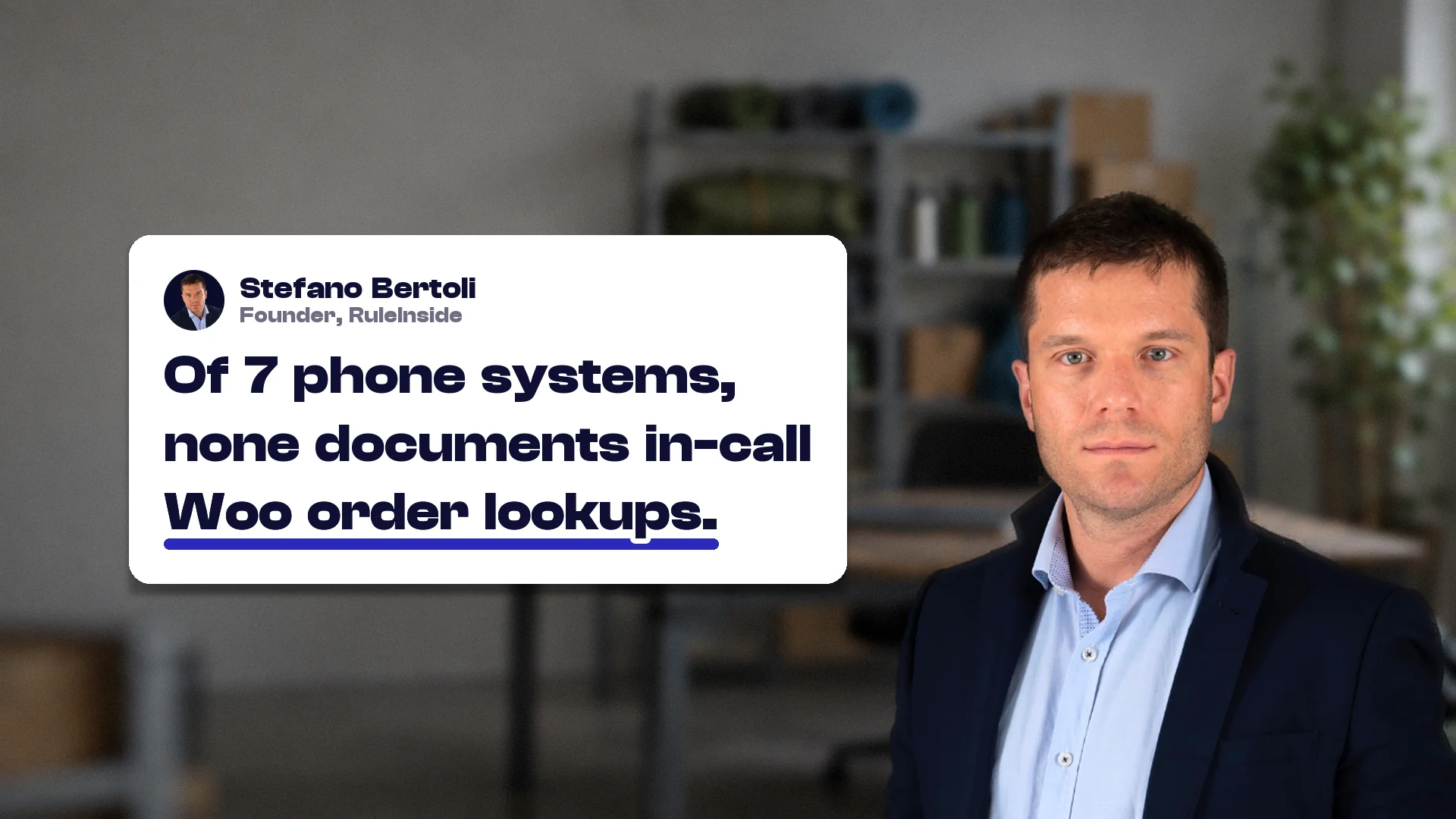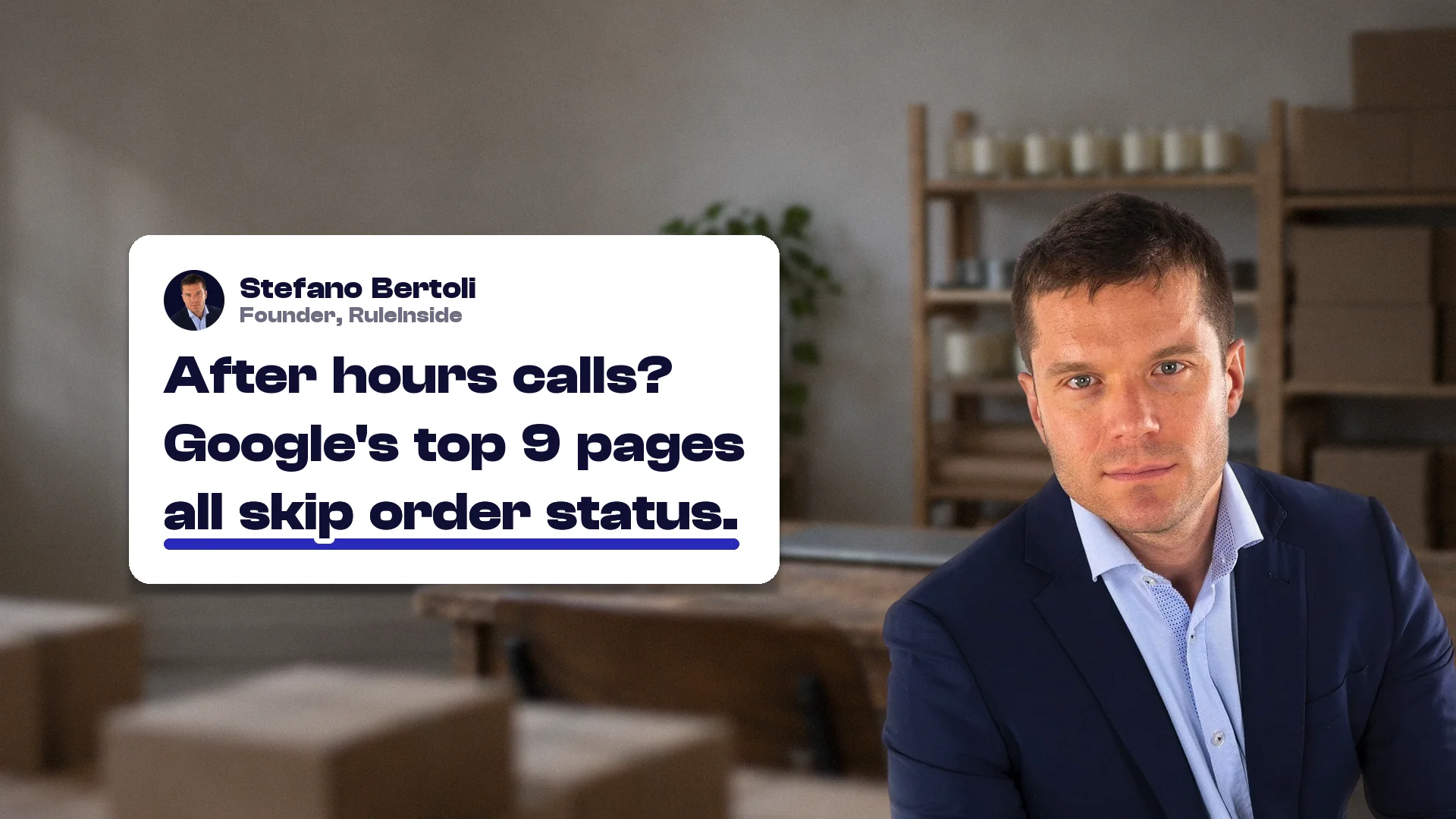

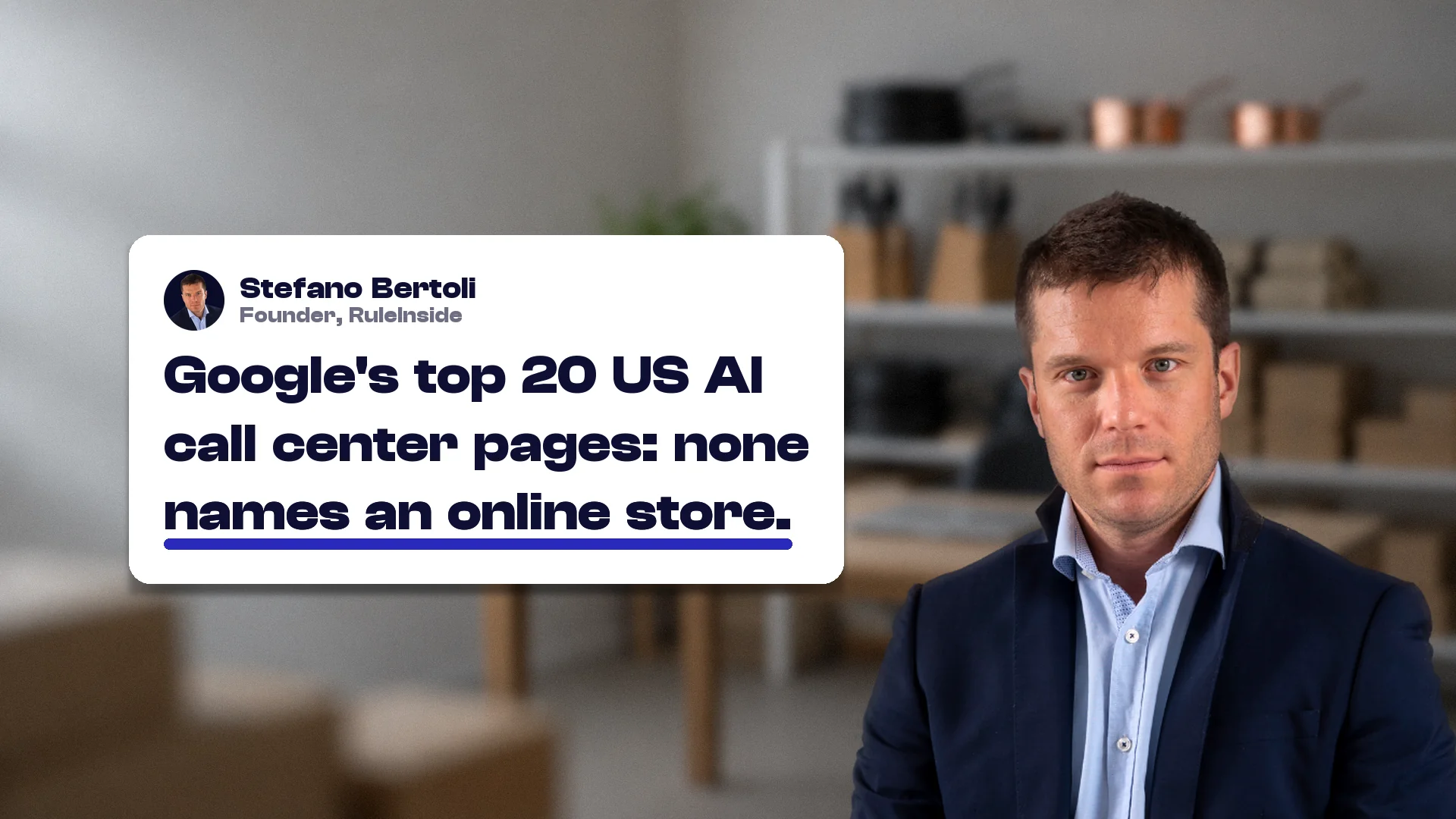
The phone rings while you pack the morning’s orders. A customer wants to know if a size runs small. You answer, and the next parcel waits.
One store owner put it plainly on Reddit. The phone was “taking up a lot of my time answering calls and interupting my workflow”.[1] So you search for an AI call center. The results describe software for contact centres with agents and supervisors. A store run by two people has neither.
I’m Stefano Bertoli, founder of RuleInside. I spent the last year testing AI voice platforms on real stores, then built RuleInside. RuleInside sells an AI agent that answers store calls, so read this knowing I sell one. This guide explains what an AI call centre is and does for a store, and what it must never decide.
Key takeaways
- An AI call centre can be one of three products: an AI agent that answers callers, AI that helps a person on the call, or AI that calls customers. A store with no phone team needs the first.
- None of Google’s top 20 results for ai call center in the US names WooCommerce, WordPress or an online store. 16 of the 20 publishers sell software or services for contact centres, AI voice or phone lines.
- On our demo store, the AI agent asked for the order’s email and postcode before looking the order up. It offered to connect me with a person about the address. It said a refund request goes to the team for review.
- Customers want a way out when a company answers with generative AI. In a 2026 Gartner survey, 87% of 3,566 customers called a route to a human essential.
What is an AI call center?
An AI call centre is a phone operation where software handles part of every call. The name covers more than one product, and most of the top guides blend them.
The first is an AI agent that talks to the caller. It answers the question, looks up what it needs, and ends the call or passes it on. The second is agent assist: AI that helps a person who is on the call. IBM describes agent assist as AI that gives customer service representatives “relevant information in real time”.[2] IBM sets agent assist apart from an AI agent, which “completes tasks autonomously or on behalf of users”.[2] IBM sells AI software for customer service.
A third kind places calls instead of answering them. Google’s top 20 pages for ai call center mostly blur the line. 13 of them mix two or more kinds in one definition, and 9 mix answering with assisting.
| Kind | Who talks to the caller | Does it need a phone team? |
|---|---|---|
| AI agent | The AI, from start to finish or until it passes the call on | No. A person takes only what the AI cannot answer |
| Agent assist | Your staff, with AI prompts and summaries on screen | Yes. It helps people who are already on the phones |
| Outbound AI calls | The AI, calling customers on a list | No, but the customer must agree to the call first |
A store with nobody on the phones has no one for agent assist to help. So for a small store, an AI call centre means an AI agent that answers. You will also see it called an AI contact center when it covers chat and email too. Our guide to what voice AI is explains how an AI voice agent differs from a phone menu.
Bottom line: with no phone team, your AI call centre is an AI agent that answers the calls itself.
How does an AI call center answer a call?
An AI agent on a phone line works in a loop. It turns the caller’s speech into text, decides what to say, and speaks the answer.
OpenAI’s guide for developers names those three stages: speech to text, the agent workflow, and text to speech.[3] It also describes a single model that can “interpret audio, decide what to do, and respond in speech”.[3] Phone companies sell the voice parts too. Twilio offers to “handle the heavy lifting of speech recognition, text-to-speech, and voice synthesis”.[4] The business supplies the part that decides.
That deciding part is where a store’s calls are won or lost. An agent that cannot read your store can only repeat your help pages.
What it needs to read from your store
On WooCommerce, software with an API key can retrieve a single order.[5] An API key is a password your store gives another program, so it can read your data. The order carries its status, its dates, the items, the billing and shipping addresses, the shipping method and any refunds. The key can be read-only, so an agent that only answers questions never needs to change your orders.
WooCommerce’s own order record does not hold a tracking number. Its Shipment Tracking extension “lets you add a shipping provider, tracking number, tracking link, and shipped date to an order”.[6] So whether an agent can read a tracking number out depends on your plugins.
Speed matters on a call. OpenAI tells developers to measure how long callers wait for a useful spoken answer, on typical and slow calls.[3]
Bottom line: the voice is the easy part. What an AI call centre can answer depends on what it reads from your store.
Why are AI call center guides written for big teams?
The companies that write them sell to big teams. I read Google’s top 20 pages for ai call center in the US. 16 of the 20 publishers sell software or services for contact centres, AI voice or phone lines.
16 of the 20 use the words contact center, and 10 say enterprise. Small business appears on 3, each in passing. The two lists of the best software among them price many products per user or per agent each month. A price per seat assumes you have seats to fill.
None of the 20 names WooCommerce, WordPress or an online store. Order status appears on 10, and on 8 of them as one item in a list of routine requests. Only one page walks through a store’s phone call step by step: a vendor’s return and refund example.
The hand-off goes to human agents. 13 pages cover passing a call to a human, and none describes passing it to an owner’s own phone. None explains the consent law for recording a call, and 2 mention telling callers they are speaking to an AI.
And none of the 20 says it tried an AI call centre as a customer would, then reported what happened. I tried our own demo store’s agent, and the results are later in this guide.
Bottom line: the top guides answer a contact centre manager’s questions, not a store owner’s.
What calls does an online store get?
An online store mostly gets calls about products, orders and deliveries, and fewer of them than a contact centre does.
I read Reddit posts from 2024 to 2026 in which store owners talk about their phones. Most of them post in r/ecommerce or r/shopify, and few in r/woocommerce. Among the store owners who said why customers call, 6 named orders placed or paid by phone. 5 named product, fit or stock questions, and 2 named delivery or order status. Our guide to automated phone systems had a larger sample: 29 of 45 owners named phone orders and card payments.
“Most phone calls we receive are for product recommendation based on use case”
Three owners said older customers are among the people who call. Most owners who state a volume get between no calls in seven months and a few a day. One Shopify store is the exception: about 300 to 500 support calls a month, alongside about 1,500 emails and chats.
The phone is not fading. Gorgias sells a help desk to online brands. Across 10,990 brands that use it, phone calls logged in its help desk rose 20% from early 2024 to early 2026.[8] A Gorgias page last updated in 2023 puts where is my order questions at 18% of incoming requests on average. It does not name the channels.[9] In a ContactBabel survey of 1,000 US consumers, 42% preferred the phone for reporting an incorrect delivery.[10] Two of the report’s three sponsors, UJET and Enghouse Interactive, sell contact centre software.
Bottom line: most stores that give a volume get a few calls a day at most. Their callers ask about products, orders and deliveries.
Does a small store need an AI call center?
A small store needs one only if calls go unanswered, or answering them costs you time you need elsewhere. Many owners answer the phone themselves, and some stop offering a phone line.
49 people who run or work for an online store described how they handle calls, or would. Their answers can overlap. 21 answer calls themselves or with their own staff. 11 have no phone line that a person answers, and 2 more are thinking of dropping theirs. 6 use a call centre, an answering service or a virtual assistant, and 3 did before. 3 use a phone menu, and 2 use an AI.
“Phones and chat tied up staff, a lot of it was time wasting.”
Other owners count a human voice as a selling point. One wrote that a knowledgeable human answering the phone is “one of our number one positive feedback items”.[12] If your callers buy because a person answers, keep the person.
| Option | Who answers | It fits when |
|---|---|---|
| You or your staff | You | Calls are few and you know every product |
| Phone menu | Nobody: it routes the call | You have people to route callers to |
| Answering service | A person outside your store | You want a human voice, and a message is enough |
| AI agent | Software that reads your store | Most calls ask what your products and orders can answer |
Our guides compare phone menus, AI answering services and outsourced customer service. If you hire instead, the median US customer service representative earned $21.53 an hour in May 2025, before benefits.[13]
Bottom line: an AI call centre fits a store whose calls go unanswered and ask what its data already knows.
What did an AI agent do when I tested it on our store?
It asked for proof before reading an order, and passed on anything that changes an order or moves money. I tested our own demo store’s AI agent by text chat on 24 October 2026.
The store is Velàri Skincare, our demo shop, not a client’s store, and the agent is ours. I asked four questions in one session, the way a caller might ask them. The store’s voice widget shows no transcript of a call, so I tested by text.
| I asked | The agent replied |
|---|---|
| Person or AI? | It said it is an AI assistant for the store |
| Where is order 1001? | It asked for the order’s email and billing postcode first, to verify the order |
| Change the address? | It said it cannot, and offered to connect me with a person |
| Cancel and refund? | It asked for the order details and a reason, to submit the request for the team to review |
These limits are deliberate, not gaps. It did not change the address, and it did not approve the refund. Those go to a person.
I did not give it a real order’s email, so the test stops before a lookup. Our AI voice agent page says the agent reads back the status, the items and the tracking number. The tracking number needs your shipping plugin. RuleInside builds this agent, so weigh my account with that in mind.
Bottom line: a store’s AI agent should answer from the order and pass anything involving money to a person.
What should an AI call center never decide?
An AI call centre should never decide anything that moves money or changes an order. The AI agent takes the request, and a person decides.
Store owners say the same thing. One wrote that they “would not want AI to have the power to issue refunds”.[7] Another would only use an AI service that takes on “the legal liability” for what its AI says.[14]
That worry has a precedent. In 2024 a Canadian tribunal ruled on Air Canada’s website chatbot. It had told a customer he could claim a bereavement fare after travelling. Air Canada did not allow that. The tribunal found the airline “responsible for all the information on its website”, chatbot included.[15] It ordered Air Canada to pay 812.02 Canadian dollars.
It was a small-claims case about a website chat, not a phone call, and not US law. The lesson still travels: what your agent tells a customer, your store has told them.
So set the limits before the first call:
- Let it read orders, stock and your written policies.
- Let it take refund, cancellation and address requests, with the order attached.
- Send those requests to you, and let a person approve them.
- Make it say so and pass the call on when it cannot find the answer.
Bottom line: an AI call centre answers, and a person decides anything that costs your store money.
What happens when a caller wants a person?
A good AI call centre passes the call on quickly, and tells the person what the caller wanted. Customers expect a route to a person.
Gartner surveyed 3,566 customers in 2026. 87% said a company using generative AI must offer “an option to reach a human agent”.[16] Gartner says service leaders should “not use GenAI as a mandatory first step for every issue”.[16] Two years earlier, customers’ top worry about AI in service was that reaching a person would get harder.[17]
One store owner who uses an AI receptionist described the setup. When a caller asks for a human, “it will transfer the call during regular business hours”.[18] Outside those hours it takes a message. The same owner says the team listens to every call.
In a contact centre, the hand-off goes to an agent’s queue. In a store with no phone team, the person is you. The call should ring your phone with the order already looked up, so the caller does not start again. Our agent transfers the call live to your phone or your team. If nobody picks up, it records what the caller wanted and confirms the next step with them.
Bottom line: make reaching a person easy, and send the hand-off to the phone of whoever can fix the problem.
Will an AI call center replace your staff?
In a store with no phone team, it replaces nobody: it answers calls that nobody answers now. In large contact centres, the picture is mixed.
The US Bureau of Labor Statistics projects employment of customer service representatives to decline 5% from 2025 to 2035.[13] It expects less demand for these workers, “especially in retail trade, as their tasks continue to be automated”.[13] It expects some companies to keep in-house teams, “particularly for complex inquiries such as refunding accounts or confirming insurance coverage”.[13]
Gartner predicts that by 2027, half the companies that planned sharp cuts to service staff will drop those plans.[19] In its poll of 163 service leaders, 95% planned to keep human agents.
Klarna tried AI in customer service at scale. In 2024 Klarna said its chat assistant handled two-thirds of its service chats in its first month. Klarna called that “the equivalent work of 700 full-time agents”.[20] Those were chats in its app, not calls, and the figures are Klarna’s own. In 2025 Klarna said customers should always be able to reach a human.[21] Its chief executive told Bloomberg that cost had been “a too predominant evaluation factor”, and the result was “lower quality”.[22]
Software can shrink a team without an AI on the phone. A subscription store cut “20 customer service reps in a call center” to “1 person + Gorgias”, one of its staff wrote.[23] Gorgias is a help desk.
Bottom line: in a small store, an AI call centre covers calls that go unanswered. It replaces no team.
What must an AI call center tell callers?
It must say the call is recorded, where state law asks for it. In Utah, it must also say it is an AI when a caller asks. This is a summary, not legal advice.
Recording the call
Federal law lets a call be recorded when one party consents.[24] States can be stricter. 13 states need every party’s consent to record a phone call, by our count from a press freedom group’s guide. For Michigan, the guide is sure of this only when an outsider records.[25] It says consent is presumed when the parties “are warned of the recording and continue with the conversation”. So a store’s AI agent should say at the start that the call may be recorded.
Saying it is an AI
Utah requires a business whose generative AI talks to a customer to say so if the customer asks.[26] Another section of the law protects a business whose AI says it is an AI from the start and throughout.[27] On our demo store, the agent’s first reply named itself an AI assistant.
Calling customers back
The FCC ruled in 2024 that AI-generated voices count as “artificial” under the Telephone Consumer Protection Act.[28] A business needs the customer’s prior consent before such a call. The ruling covers calls a business makes, not calls it answers. Our guide to voice AI has more on the first sentence a caller should hear.
Bottom line: announce the recording, tell callers they are speaking to an AI, and get consent before AI calls customers.
How do you test an AI call center before your store uses it?
Call it with your own customers’ questions, then watch what it does with the hard ones. Run the first seven in an afternoon, and the last in your first week:
Your common questions. Ask about a product’s size, a delivery time and an order.
A real order and a wrong one. It should check who is calling, and say when an order does not exist.
A change. Ask it to change an address or cancel an order. It should pass the request to a person.
A refund. It should take the request and the reason, and never approve the refund itself.
Is it an AI? Ask. It should say so plainly.
A person, please. Ask during your hours and outside them, and see where the call goes.
The tracking number. Check that it can read one from your shipping plugin.
The first week’s calls. Read every transcript, and fix the answers it got wrong.
What setting one up involves
Setup is mostly decisions, not code. You give the AI agent read access to your orders and products, through a key like WooCommerce’s read-only one.
You write down the policies it may quote: delivery times, returns and what happens to a damaged parcel. You choose whose phone rings on a hand-off, in hours and out of them. And you decide on your number: forward your calls to the agent, or move the number to the provider.
Timelines in Google’s top results run from hours to six months, and every one comes from a vendor. Ask any vendor who does each of these steps, and who updates the answers when a policy changes.
What to measure after launch
Four numbers tell you whether it works: the calls it answers without a person, the calls it hands over and why, the wrong answers in the transcripts, and how long callers wait for a useful answer. OpenAI tells developers to track that last one.
Then compare the cost. AI call centres are priced per minute, per call, per caller, per seat or as a monthly bundle. Our voice AI pricing guide turns a price into a cost per call. Set that beside what answering by hand costs you now.
Bottom line: test an AI call centre on your hardest calls. Judge what it refuses as well as what it answers.

Free tool · your next step
Work Out What Your Calls Cost You Now
Before you price an AI call centre, put a number on what your calls cost today. The calculator works out what answering by hand costs your store.
- On the Save Costs tab, enter how many support conversations you get a month.
- Enter what support costs you a month, staff time included.
- See the hours handed back, and what those hours were costing.
- On the Increase Revenue tab, estimate what unanswered questions cost in sales.
It is an estimate from your own figures, not a promise. It asks for your email before it shows the results.
Open the ROI CalculatorQuestions Store Owners Ask About AI Call Centers
An AI call centre uses software to handle part of each call. It can be an AI agent that answers callers, or AI that helps people on the phones.
A store without a phone team needs the first kind. The agent answers, and passes the call to a person when needed.
The AI agent turns the caller’s speech into text, decides on an answer, and speaks it back. Some systems do all three in one model.
The answer is only as good as what the agent can read. For a store, that means the order, the stock level and your written policies.
An AI agent can answer routine questions. Customers and service leaders still want a person within reach for complaints, exceptions and anything involving money.
Gartner’s poll of 163 service leaders found 95% planned to keep human agents.[19] A small store usually has no phone staff to replace: the AI covers calls nobody answers.
The Bureau of Labor Statistics does not name AI. It projects customer service representative jobs to fall 5% from 2025 to 2035, as tasks are automated.[13]
It still expects about 289,500 openings a year, and some companies to keep in-house teams for complex questions.
The FCC’s 2024 ruling covers AI calls a business makes: the customer must agree to them first.[28] It does not cover calls an AI answers.
Answering still has rules. About a dozen states need every party’s consent to record a call. Utah requires an AI to say it is one if asked. This is a summary, not legal advice.
It depends on how it is priced: per minute, per call, per caller, per seat or as a monthly bundle. Two best-software lists in Google’s top results price many products per user or per agent each month.
Our voice AI pricing guide turns each unit into a cost per call at a store’s volume. Then weigh that cost against what answering by hand costs you today.
An AI call centre handles phone calls. An AI contact centre covers the phone plus chat, messaging and email.
Salesforce draws the same line: an AI call centre “focuses primarily on phone interactions”.[29] For a store, one AI agent on both the phone and chat means one set of answers to keep current.
It is the software a call centre buys to add AI: agents that answer, prompts for staff, transcripts and call scoring.
Much of it is priced per user or per agent, for teams with supervisors. A store without a team needs the answering part, connected to its orders.
It is worth it when calls go unanswered or take time you need elsewhere. If you get one or two calls a week, answering them yourself may be enough.
If your customers choose you for a human voice, keep it. Use the ROI Calculator to put a number on the time calls take today.
Yes, if it is connected to your store. On WooCommerce, an agent with an API key can read an order’s status, items, addresses and refunds.[5]
It should check who is calling first. The tracking number comes from a shipping plugin, not from WooCommerce’s own order record.

How I wrote this guide
Who wrote it. I did. I run RuleInside, which builds and runs AI voice agents for WordPress stores. So I sell one kind of AI call centre.
The top-ranking pages. I read Google’s top 20 results in the US for ai call center on 24 October 2026. Ubersuggest recorded those rankings on 4 September 2026. One page blocked scripts, so I read it in a visible browser. I read a Reddit post through an archive’s public API, and a video from its title and description. I used code to count what each page covers, then checked by hand every match the code found.
Owners. I read Reddit posts and replies from 2024 to 2026 about store phones, call centres and AI. They come from a local copy of four subreddits. The copy of r/smallbusiness starts in October 2025. Where a post did not show whether its author runs a store, I read the author’s other posts. I quote as store owners only those I could confirm. Most post in r/ecommerce or r/shopify, and few in r/woocommerce.
Sources. I read every source on 24 October 2026, and the Reddit posts in our local copy. Gartner, the Bureau of Labor Statistics and Staffing Industry Analysts blocked automated requests, so a script opened them in Chrome. Bloomberg’s own page refused me, so its interview is cited through a credited reprint.
The demo store. On 24 October 2026 I sent our demo store’s agent four messages in its text chat, through an automated test. This guide reports what it answered.
AI help. I used AI to gather and check the sources and to write the first draft. Every figure is checked against its source.
Updates. I revise this guide when the facts change. The date at the top shows the last real update.
Sources
- A post on r/ecommerce, 7 November 2024. Read the source
- IBM, “What is Agent Assist?”, IBM Think, updated 17 November 2025. IBM sells AI for customer service. Read the source
- OpenAI, “Voice agents”, OpenAI API documentation, read 24 October 2026. OpenAI sells the speech and language models. Read the source
- Twilio, “Conversation Relay”, Twilio documentation, updated 24 August 2026. Twilio sells phone numbers and voice calling. Read the source
- WooCommerce, REST API Documentation (WP REST API v3), read 24 October 2026. Read the source
- WooCommerce, “Shipment Tracking” documentation, updated 10 July 2026. Shipment Tracking is a paid WooCommerce extension. Read the source
- A reply in a thread on r/shopify, 16 September 2024. Read the source
- Gorgias, “Email isn’t dying, chat is doubling. But it’s not that simple.”, Gorgias Ecom Lab, 19 May 2026. Gorgias sells an ecommerce help desk. Read the source
- Gorgias, “What’s The Secret to Reducing WISMO Requests?”, updated 13 November 2023. Read the source
- Steve Morrell, “The Return to Voice”, Contact Center Pipeline, March 2026, reporting ContactBabel’s US Customer Experience Decision-Makers’ Guide. Two of its three sponsors, UJET and Enghouse Interactive, sell contact centre software. Read the source
- A reply in a thread on r/ecommerce, 31 January 2026. Read the source
- A reply in a thread on r/shopify, 13 July 2025. Read the source
- US Bureau of Labor Statistics, “Customer Service Representatives”, Occupational Outlook Handbook, modified 27 August 2026. Read the source
- A reply in a thread on r/shopify, 15 September 2024. Read the source
- Civil Resolution Tribunal of British Columbia, Moffatt v. Air Canada, 2024 BCCRT 149, 14 February 2024. Read the source
- Gartner, “Gartner Survey Finds 87% of Customers Say Companies Using GenAI for Customer Service Must Provide Access to a Human Agent”, 4 August 2026. Gartner sells research and advice. Read the source
- Gartner, “Gartner Survey Finds 64% of Customers Would Prefer That Companies Didn’t Use AI For Customer Service”, 9 July 2024 (a survey of 5,728 customers, December 2023). Read the source
- A reply in a thread on r/smallbusiness, 15 June 2026. Read the source
- Gartner, “Gartner Predicts 50% of Organizations Will Abandon Plans to Reduce Customer Service Workforce Due to AI”, 10 June 2025. Read the source
- Klarna, “Klarna AI assistant handles two-thirds of customer service chats in its first month”, 27 February 2024. Read the source
- Kristen Doerer, “Klarna changes its AI tune and again recruits humans for customer service”, CX Dive, 9 May 2025. Read the source
- Bloomberg News, reprinted by Staffing Industry Analysts as “Fintech firm pauses AI push, adds back human touch”, 13 May 2025. Read the source
- A reply in a thread on r/shopify, 29 June 2025. Read the source
- 18 U.S. Code § 2511(2)(d), Legal Information Institute, Cornell Law School. Read the source
- Reporters Committee for Freedom of the Press, “Introduction to the Reporter’s Recording Guide”. The count of 13 states is ours, from its two lists. Read the source
- Utah Code § 13-77-103, effective 7 May 2025, Utah State Legislature. Read the source
- Utah Code § 13-77-104, effective 7 May 2025, Utah State Legislature. Read the source
- Federal Communications Commission, Declaratory Ruling FCC 24-17 on AI-generated voices in robocalls, released 8 February 2024. Read the source
- Salesforce, “What is an AI Contact Center? Key Features & Benefits”, updated 30 September 2026. Salesforce sells contact centre software. Read the source
On this page