
A growing store reaches a week with more work than hours. Then its owner has to decide which jobs to hand to someone else, and to whom.
We wanted the answer store owners give each other, not the one vendors give. So we counted what owners say. We collected every post in three store-owner communities on Reddit for a full year: 31,381 posts. Then we classified the 1,886 that mention hiring or outsourcing.
Key findings
- Fulfilment and marketing are the jobs established store owners raise most when handing off work, in every version of the count.
- Where two AI readers agreed, fulfilment led, in 22 of 85 hand-off posts (26%). In 17 of those 22, owners named a 3PL, an outside warehouse that packs and ships orders.
- Marketing came second, in 17 of the 85 posts (20%), and 13 of those 17 named an agency.
- Customer support sat mid-table, in about 1 in 8 of those 85 established hand-off posts (11 of 85).
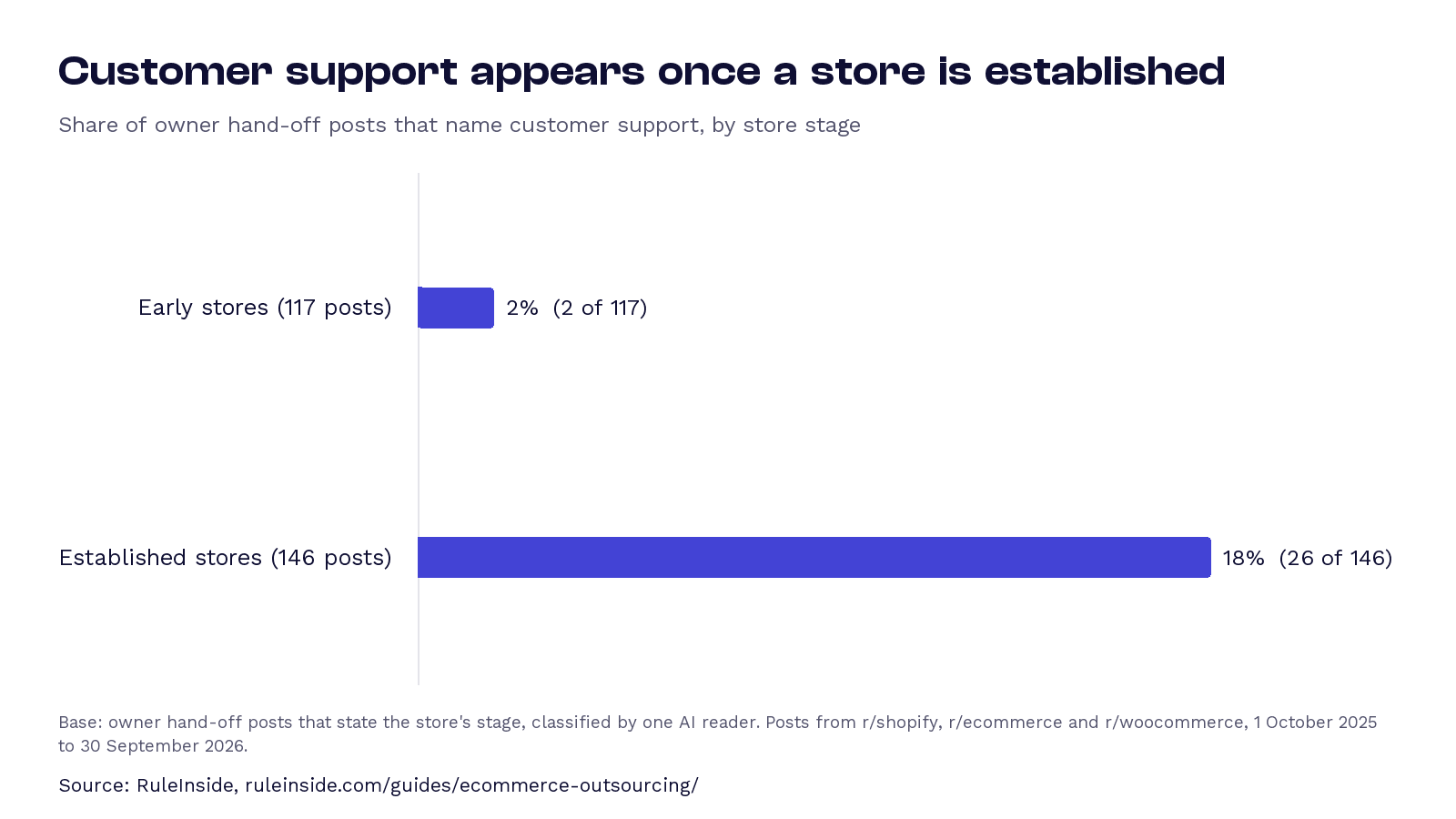
- Support almost never came up for early stores: 2 of 117 posts. On one AI reader’s count, established stores raised it in 26 of 146.
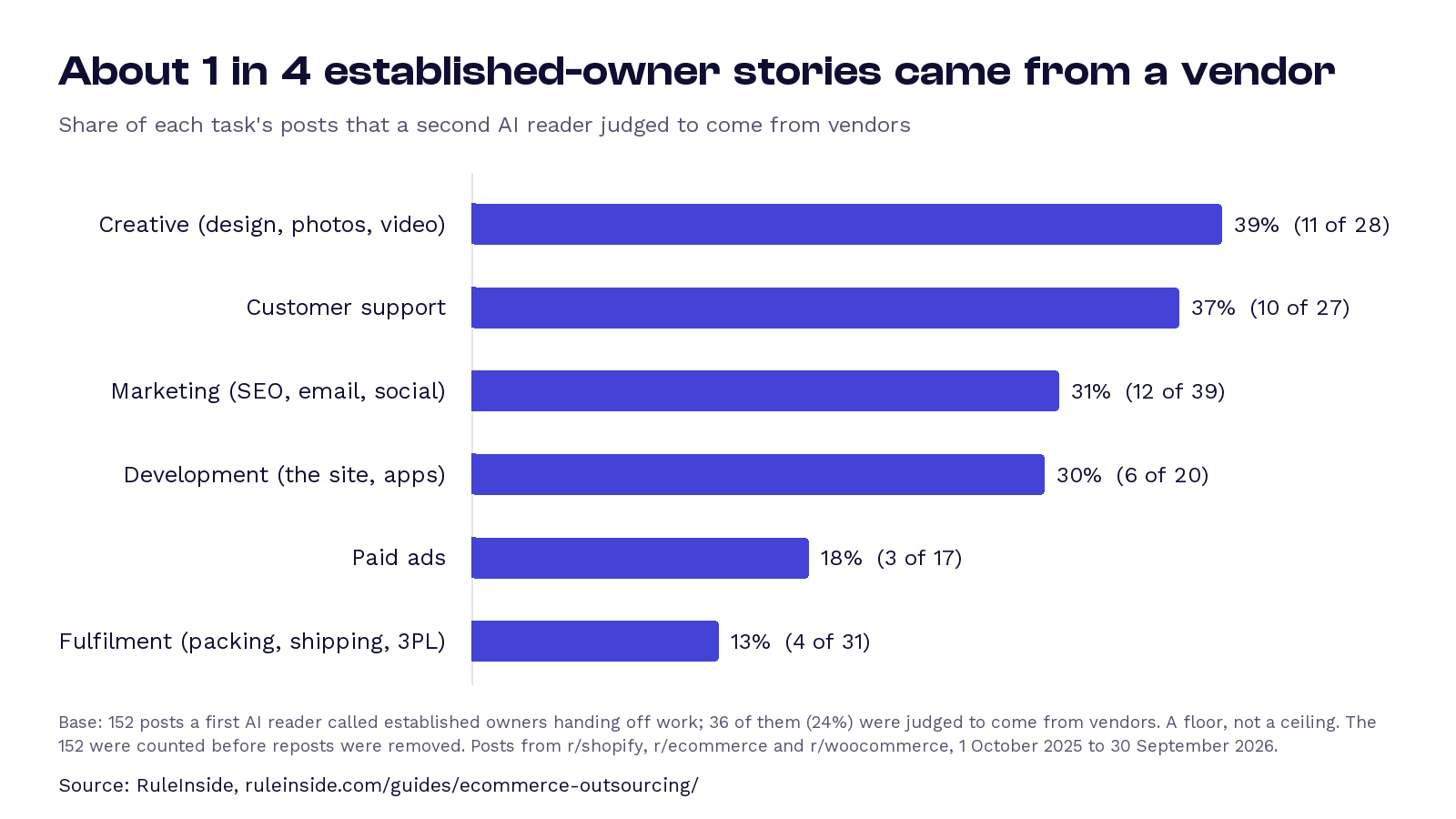
- A second AI reader judged 36 of 152 established-owner posts (24%) to come from vendors. Most were stories ending in a plug.
You are free to quote this study and to reuse its charts. Please credit RuleInside and link to this page. The downloads, a citation line and a press contact are in the section Using this research, below.
What did we count, and how?
We took every post published in r/shopify, r/ecommerce and r/woocommerce between 1 October 2025 and 30 September 2026.[1][2][3][4] That is 31,381 posts: the whole year, not a sample of it.
A wide filter kept 1,886 posts that named one of these: hiring, outsourcing, a virtual assistant, an agency, a freelancer, staff or a 3PL. AI readers then classified each one against a written codebook, the rules every reader followed.
Of the 1,886, 549 were posts by store owners handing work to someone else, or asking about it. They came from 508 different authors, and a repost of the same question counted once.
Most posts ask about a hand-off rather than report one. Of the 549, 391 asked about a hand-off, 140 reported one, and 18 described taking work back.
In 263 of the 549 posts, the owner said enough to place the store: 117 early and 146 established. Established means the post showed steady trading. Signs included about $5,000 a month or more in sales, or about five orders a day. Paid staff or contractors already at work also counted.
Of the 549 posts, 193 came from r/shopify, 336 from the general r/ecommerce and only 20 from r/woocommerce. So the findings say little about WooCommerce stores in particular.
Bottom line: The study counts what a year of store owners on Reddit asked or said about handing work off. It does not measure what every store does.
What do established store owners hand off?
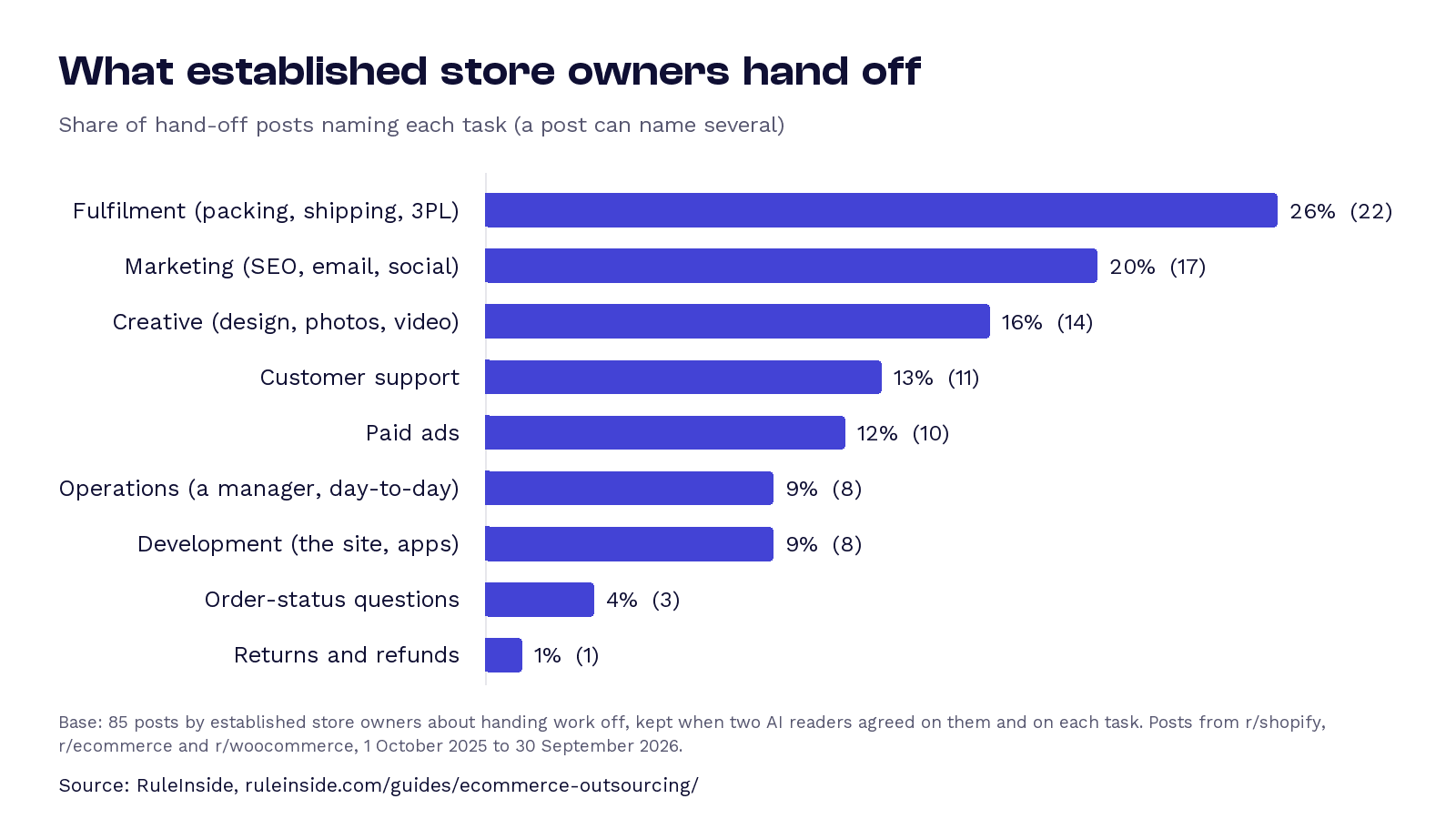
Established stores hand off fulfilment and marketing most, whichever way you count. Customer support sits in the middle of the table, and returns come up rarely.
We give three versions of the count, from the widest to the strictest. The chart uses the middle one: the 85 established hand-off posts that two AI readers, working separately, both accepted.
A post can name several tasks. A low share means few hand-offs, not that the job matters less. Source: RuleInside.
| Task | One AI reader, 146 posts | Two readers agree, 85 posts | Builder accounts removed, 73 posts |
|---|---|---|---|
| Fulfilment | 21% | 26% | 29% |
| Marketing | 25% | 20% | 22% |
| Creative | 19% | 16% | 12% |
| Customer support | 18% | 13% | 10% |
| Paid ads | 11% | 12% | 14% |
| Operations | 11% | 9% | 11% |
| Development | 13% | 9% | 10% |
| Order status | 7% | 4% | 4% |
| Returns | 3% | 1% | 1% |
The strict sets are small, so read the order and the ranges, not the exact shares. In the widest count, the 95% ranges overlap: marketing 18% to 32%, fulfilment 15% to 28%, support 13% to 25%.[5]
Marketing leads the widest count and fulfilment the strict ones, but the ranges overlap, so that swap may be chance. In all three, the same two jobs lead.
The study counts how often a job comes up, not the order an owner hands jobs off. Most of these posts are owners asking about a hand-off, not reporting one.
The third column drops builder accounts. Those have at least 3 posts in software-builder communities, and no fewer there than in store ones. Dropping them changes the middle of the table, not the top.
Bottom line: Fulfilment and marketing are the jobs established owners raise most often. Which of the two leads is less certain than the fact that they lead.
Fulfilment: who takes the packing and shipping?
Fulfilment covers packing, shipping, the warehouse and order processing. In the strict count, 22 established hand-off posts named it, and 17 of those 22 named a 3PL.
A 3PL, or third-party logistics company, holds a store’s stock and packs and ships each order. In 3 of the 22 posts, the owner named their own staff for the job instead.
Fulfilment comes up at both stages. In the widest count, it came up in 30 of 117 early-store posts and in 30 of 146 established ones.
One owner described the trade plainly. They run a beauty brand with their partner, and had been selling for two years.
“the big one is that we no longer pack and ship the products. Outsourcing it saved us about 15-30 hours a week that could now be spent elsewhere”
The same post says the store’s overhead went up a lot as a result.[6] Another owner, who runs preorders, had used one 3PL for about two years and valued the time it freed.
“being able to fully let go of what used to be hours and hours of my life was priceless”
The same owner then worked out the cost. From April 2024 to February 2026, they paid the 3PL about $85,000, against about $50,000 that customers paid for shipping.[7]
Bottom line: In the strict count, fulfilment is the top hand-off, and most of those posts name a 3PL.
Marketing and paid ads: who takes them?
Marketing here means SEO, email, social media, content, influencers and copywriting. Paid ads on Meta, Google or TikTok are counted on their own.
In the strict count, 17 established hand-off posts named marketing, and 13 of those 17 named an agency. Paid ads came up in 10 posts, and 7 of those 10 named an agency.
So marketing and paid ads are the hand-offs where an agency is the usual answer. A freelancer came second: 2 of the 17 marketing posts and 3 of the 10 ads posts named one.
One owner, who runs a high six-figure brand with their partner, had hired and fired several agencies. Their post ends on the problem this study is about.
“I’m still trying to figure out how to create a team to grow this company without hiring full-time employees. We’re just not big enough for that. So we’re stuck with agencies or contractors.”
The owner planned to run email in-house with a hired designer. Paid ads would go to a smaller agency or a contractor.[8]
Bottom line: In the strict count, marketing is the second job established owners hand off, and agencies take it most often.
Creative work and development: who takes them on?
Creative work means design, product photos and video. It came up in 14 of the 85 strict-count posts, with freelancers named in 10 of them.
In 4 of those 14 posts, the owner named software or an AI tool for the creative work. Two of the 14 named an agency.
Creative work also had the highest share of vendor pitches, as a later section shows. So its share among real owners is less certain than the others.
Development means building the store, its theme, apps and plugins, and keeping them running. For established stores it is a small hand-off: 8 of the 85 strict-count posts.
In the widest count, it is the top hand-off for early stores: 31% of their posts, against 13% for established ones. No job differs more between the two stages, and the stage section below covers it.
Bottom line: Established owners mostly give creative work to freelancers. They hand off development far less than new stores do.
Where does customer support sit?
Customer support sits in the middle of the table. It came up in 11 of the 85 strict-count posts, about 1 in 8.
In the widest count it is 26 of 146 posts (18%). With builder accounts removed, it is 7 of 73 (10%).
So support is not the job established owners raise most. Fulfilment and marketing come before it in every version of the count.
We do not publish who took the support work. The strict count is only 11 posts, and it still holds vendor accounts, so a split by provider would mislead.
Order-status questions came up in 3 of the 85 posts, and returns in 1. Answering the phone came up in 2 of all 549 hand-off posts.
A low count here does not mean owners do not need the job done. The study counts hand-offs to options owners know exist. A job they do not know they can hand off will rarely appear.
Bottom line: Customer support is a mid-table hand-off for established stores, behind fulfilment and marketing.
How does the hand-off change as a store grows?
Customer support almost never comes up before a store is established. It appears in 2 of 117 early-store hand-off posts, and in 26 of 146 established ones.
One AI reader classified these posts, and a second reader did not read the early-store ones. Source: RuleInside.
New stores hand off building the store. Development is their top hand-off: 36 of 117 early-store posts (31%), against 19 of 146 established ones (13%).
“Is hiring a Shopify Expert worth it as a small clothing brand?”
Established stores hand off running the store. Their top hand-off in the widest count is marketing, at 36 of 146 posts (25%).
Our reading of the posts: support becomes a hand-off question once there are customers to answer. The data shows the direction; it cannot show the reason.
Bottom line: A new store hands off building the store, and an established one hands off running it, support included.
How many “owner” stories came from vendors?
About 1 in 4 did. Working blind, a second AI reader checked the 152 posts the first reader had marked as established owners handing off work.
That base of 152 was counted before reposts were removed, so it is larger than the 146 used elsewhere.
The second reader was told that a pitch written as an owner story counts as a vendor post. It judged 36 of the 152 posts (24%) to come from vendors.
Its notes on those 36 mostly describe a story that ends in a plug for a product, a tool or an agency.
The posts date from October 2025 to September 2026. The first AI reader named the task. Each task has few posts, so read the order. Source: RuleInside.
Creative work and customer support had the highest shares, with marketing and development close behind at about 30%. Fulfilment, the top hand-off in the strict count, had the lowest.
Reading the example accounts in full made the pattern plain. One account posted one template, adapted for different trades, across 52 subreddits. A ring of accounts posted one product into unrelated communities.
The 24% is a floor, not a ceiling. The post histories of authors both readers accepted showed more vendor accounts that neither reader had caught.
Rule 2 of Reddit’s rules asks users to participate authentically, and not to spam or manipulate content.[10] Vendor posts written as owner stories go against it.
Bottom line: About 1 in 4 established-owner stories came from a vendor, and the true share is likely higher.
What happens when owners take the work back?
A hand-off is not always final. In the widest count, 18 of the 549 posts were about taking work back in-house.
Creative work came up in 7 of those 18 posts and marketing in 6, the two largest groups. Paid ads came up in 4, fulfilment in 3 and development in 2.
In the strict count there were 5 such posts. Two named fulfilment, two named paid ads and two named creative work, with one post naming both ads and creative.
These counts are too small to rank the jobs against each other. They show that owners do reverse a hand-off, and that reversals happen across several jobs.
Bottom line: Some owners take work back, most often creative work and marketing, in counts too small to rank.
What does this mean if you are deciding what to hand off?
The study describes what other owners did and asked. It cannot tell you what your store should do, but it does show where other owners started.
Start from your stage. Early owners in the study most often asked about building the store. Established owners asked about running it.
Look first where owners agree on a provider. Owners named a 3PL in 17 of 22 fulfilment posts, and an agency in 13 of 17 marketing posts.
Count both sides of the trade. Of the owners quoted above, one counted the hours saved and another counted what the 3PL billed.
Check the bill against what customers pay. The preorder owner says it took a full two years to look closely at the bills.
Check who is giving the advice. About 1 in 4 established-owner stories in this study came from a vendor.
The quickest check on a Reddit story is the author’s other posts. The vendor accounts we read in full included one posting a single template in 52 subreddits, and a ring posting one product.
Our other guides go further on several of these jobs. If support is the one you are weighing, our guide on whether to outsource customer service sets out the costs.
Our guide to customer support for ecommerce shows who answers customers at each stage of a store’s growth. To sort work between a consultant, an agency and a hire, read what ecommerce consulting covers.
Software can take a job too. Our guide to AI agents for ecommerce explains what one can do in a store. Our guide to managed AI covers who runs one.
Bottom line: Match the hand-off to your stage, start where owners agree on a provider, and keep checking the bill.
Using this research
You are free to quote this study and to reuse its charts in your own work. Please credit RuleInside and link to this page.
That is all we ask: there is no fee and no link exchange. Each chart image carries its base, its dates and the credit, so the source travels with it.
- What established store owners hand off (PNG, 1600 by 900 pixels)
- Customer support appears once a store is established (PNG)
- About 1 in 4 established-owner stories came from a vendor (PNG)
- The task counts and vendor shares, with their bases (CSV)
- The codebook the AI readers followed (text)
Suggested citation: Stefano Bertoli, “What Store Owners Outsource: A Year of Posts, Counted”, RuleInside, 2026, https://ruleinside.com/guides/ecommerce-outsourcing/.
Press contact: info@ruleinside.com. I am available for comment on the findings, and to answer questions about the data or the method.
Bottom line: Quote it and reuse the charts freely, with a credit to RuleInside and a link to this page.
How the study was done
A publisher should be able to check a study before citing it, so this section gives the method in full. Every count on this page can be recounted from the saved files.
Two steps are described here but not saved: the third read, and the second reader’s instructions.
- Data. The posts came from Arctic Shift, an archive that makes Reddit data available to researchers.[1] It was read in time order, 100 posts at a time, with no cap. Comments were not used.
- Filter. One wide pattern of hiring and outsourcing words picked the 1,886 posts to read. It only decided what was read; it decided no result.
- Codebook. A written codebook set each field: who wrote the post, the store’s stage, the kind of hand-off, the tasks, who takes them, and a quote.
- Readers. AI models read and classified the posts in batches, following the codebook. On long posts they read the first 1,500 to 2,200 characters.
- Quotes. A script checked every quote the readers copied against its post, character for character. None of the 787 quotes failed.
- Pilot. Two separate AI readers classified the same 30 posts. They agreed on whether a post was in the study for 29 of 30.
- Agreement score. That is a Cohen’s kappa of 0.91, a standard agreement score where 1 is perfect.[11]
- Second reader. A second AI reader classified all 152 established-owner posts again, blind, with a stricter rule on vendor stories. The two readers agreed on the kind of hand-off in 132 of 152 (86.8%).
- Strict count. A post counts in the strict columns only when both readers accepted it. A task or a provider counts only when both named it.
- Task agreement. Of the 98 posts both readers put in the study, they agreed on each task in 92 to 98.
- Third read. Another AI read went through all 27 support posts the first reader had marked as established, before reposts were removed. It also read 20 others at random.
- What it found. About 3 or 4 in every 20 should not have been in the study.
- Author screen. A script read the post history since 1 January 2025, up to 100 posts each, of 126 authors. They wrote the strict-count posts and every support post.
- The rule kept. At least 3 posts in software-builder communities, and no fewer there than in store communities. It flagged 22 authors.
- Builder accounts. Removing their posts takes the strict count from 85 to 73. That is shown as a separate column, never as the headline.
- Rules rejected. Three other rules were tested: posting in 15 or more subreddits, posting one title in 3 or more, and posting only once in each subreddit.
- Why rejected. Each flagged ordinary real people, so none was used.
- Repeats. An owner who reposted the same question counted once. That removed 27 posts.
- Reposts in the strict count. The repost rule was applied to the 549. The strict columns and the second reader’s 152 were counted before it.
- Their effect. They hold 3 and 5 reposts. Removing them gives 82 and 147 posts, and changes no order on this page.
- Ranges. The 95% ranges are Wilson intervals, a standard method for a share of a small sample.[5]
Among others, the rejected rules flagged a camera and motorcycle hobbyist and an airsoft player. They also flagged an owner who posted one question to three store subreddits.
Bottom line: AI readers classified the posts; a second reader, a pilot, a quote check and an author screen tested that.
What can this study not tell you?
- Not every poster is a store owner. The readers judged from the post alone whether its author owned a store. The author screen caught only some of the non-owners they let through.
- People post when they need help. So posts asking about a hand-off (391) outnumber posts reporting one (140).
- The stage is what the post says. 286 of the 549 posts gave no stage, and those are left out of every stage figure.
- WooCommerce is barely in it. r/woocommerce gave 20 of the 549 posts. The rest came from r/shopify and the general r/ecommerce.
- The count is of hand-offs, not need. A job owners do not know they can hand off will be rare here, however much it matters.
- The strict sets are small. 85 and 73 posts are enough to rank the leading jobs, not to fix their exact shares.
- The vendor share is a floor. Some pitches got past both readers and the screen.
- No person classified the posts. AI readers did, and the checks above tested their work.
Bottom line: Read the findings as what store owners discuss on Reddit, not as a census of every store.
I’m Stefano Bertoli, founder of RuleInside. We run AI agents that answer a store’s phone, chat and WhatsApp. If support is the job you are weighing up, try the free ROI Calculator. It asks how many support conversations you get a month and what support costs you.
Questions Store Owners Ask About Outsourcing
Ecommerce outsourcing is handing a store job to a provider outside the business. That can be a 3PL, an agency, a freelancer, a virtual assistant or software.
A 3PL is an outside warehouse that packs and ships orders. In this study, established owners most often raised fulfilment, usually naming a 3PL, and marketing, usually naming an agency.
In our count, established ecommerce businesses raise fulfilment and marketing most often. The study counts how often a job comes up, not the order owners act in.
Where two AI readers agreed, fulfilment came up in 22 of 85 hand-off posts and marketing in 17. Customer support came up in 11.
The study cannot say whether a 3PL is worth it for your store. It shows what owners who used one reported.
One owner said handing off packing and shipping saved about 15 to 30 hours a week, but raised overhead. Another found two years of 3PL bills far above what customers paid for shipping.
Store owners ask about handing off fulfilment both early on and once established. It came up in 30 of 117 early-store posts and in 30 of 146 established ones.
Among established stores, where two AI readers agreed, 17 of the 22 fulfilment posts named a 3PL. Three named the owner’s own staff.
Established owners who hand off marketing mostly name an agency: 13 of 17 posts where two AI readers agreed.
Owners do take marketing back. In the widest count, it came up in 6 of the 18 posts about taking work back in-house.
Yes, but customer service is not the job online stores raise most. Where two AI readers agreed, it came up in about 1 in 8 established hand-off posts.
Early-store owners almost never raised it: 2 of 117 posts. On one AI reader’s count, established owners raised it in 26 of 146.
New online stores most often ask about outsourcing the build of the store. Development was the top hand-off for early stores, in 36 of 117 posts (31%).
Fulfilment came next, in 30 of the 117. Customer support came up in 2.
Read Reddit hiring advice with care: about 1 in 4 established-owner stories in this study came from a vendor.
Creative work and customer support had the highest shares. Before you trust a story, read the author’s other posts.
This ecommerce outsourcing study collected all 31,381 posts in three store-owner subreddits over a year. It then classified the 1,886 posts about hiring or outsourcing.
AI readers followed a written codebook, and a second reader classified the established-owner posts again. The section How the study was done gives every step.
Yes. You can quote the findings and reuse the charts, with a credit to RuleInside and a link to this page.
You can download the charts, a data file of the task counts and the codebook from Using this research.

How I wrote this page
Who wrote it. I did. I run RuleInside, which builds managed AI agents for WordPress stores, so customer support is our business. The findings name no product, and our service is mentioned once, in the line before the questions.
The study. The data, the readers and every check are in the section How the study was done. The results file and the scripts that produced each figure are kept with our research.
Sources. The web sources were opened on 25 October 2026. The Reddit posts come from an Arctic Shift copy taken on 7 October 2026. They are quoted word for word, and each author’s other posts were read before quoting.
AI help. I used AI to gather and check the sources and to write the first draft. Every figure is checked against its source.
Updates. I revise this page when the data or a source changes. The date at the top shows the last real update.
Sources
- Arctic Shift, “Making Reddit data accessible to researchers, moderators and everyone else”, project page, read 25 October 2026. Read the source
- r/shopify, every post from 1 October 2025 to 30 September 2026, read through Arctic Shift. Read the source
- r/ecommerce, every post from 1 October 2025 to 30 September 2026, read through Arctic Shift. Read the source
- r/woocommerce, every post from 1 October 2025 to 30 September 2026, read through Arctic Shift. Read the source
- NIST/SEMATECH e-Handbook of Statistical Methods, “7.2.4.1. Confidence intervals”, read 25 October 2026. Read the source
- A post on r/ecommerce, “No clue how to scale a business”, 22 October 2025. Read the source
- A post on r/ecommerce, “paid 30K extra in shipping + handling because of my 3pl over 2 years; fair or freak out?”, 7 April 2026. Read the source
- A post on r/ecommerce, “Learnings after working with marketing agencies”, 22 October 2025. Read the source
- A post on r/shopify, “Is hiring a Shopify Expert worth it as a small clothing brand?”, 18 June 2026. Read the source
- Reddit, “Reddit Rules”, rule 2, read 25 October 2026. Read the source
- Mary L. McHugh, “Interrater reliability: the kappa statistic”, Biochemia Medica, 2012. Read the source
On this page