


“I’ve hired quite a few consultants over the years and have literally never had any positive results”. A store owner wrote that on Reddit in 2022.[1] In the same thread, another owner called one consultant “easily the best $10k we ever invested in our store”.[2] Same service, opposite results.
I have sat on the other side of that table. Over four years I consulted more than 30 businesses across Italy, Spain and the US, ecommerce stores among them. The same leaks showed up in every one: calls nobody answered, cart abandonment nobody could explain, past customers left untouched. Today I run RuleInside, which sells a managed AI agent. That is one of the options this guide compares, so read it knowing I sell one.
This guide explains what ecommerce consulting is, what a consultant actually does, and what it costs. It shows when hiring one pays, and when it does not. It also shows which jobs suit a consultant, an agency, a freelancer, a hire or a managed service.
Key takeaways
- A consultant diagnoses and plans. Someone still has to do the work every week after the plan.
- Ecommerce consulting pays when you have data, one clear question and someone to carry out the answer.
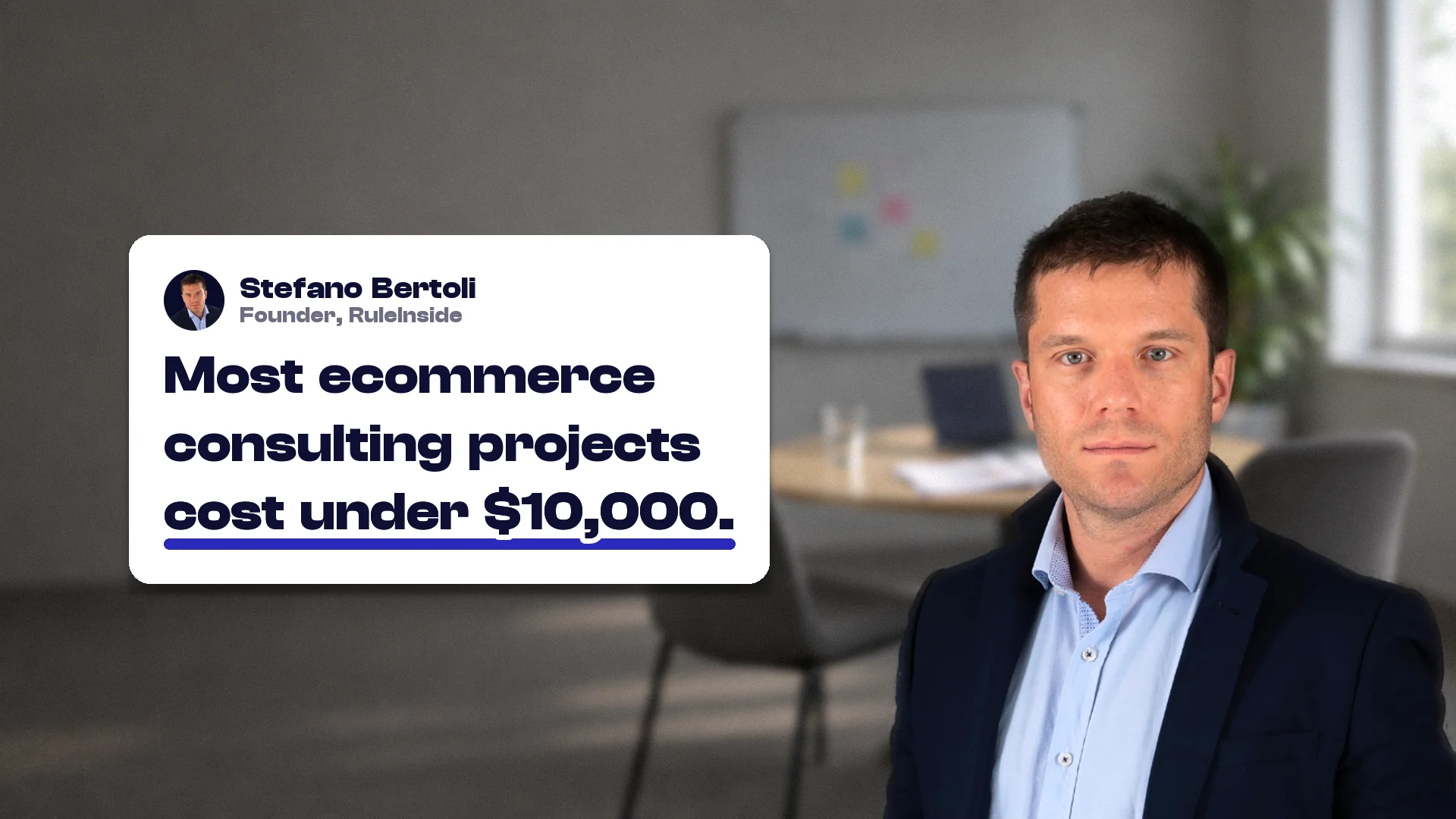
- Clutch says most ecommerce consulting projects it reviews cost under $10,000. None of the hourly ranges on page one cites a source.
- Agree the goal and how it is measured before the work starts, and ask who gets paid for each recommendation.
What is ecommerce consulting?
Ecommerce consulting is paid advice on how to run and grow an online store. A consultant looks at your numbers, finds what holds the store back and tells you what to change. Some also help you carry out the plan. Many hand it back to you, or to the people you hire.
That is the line between a consultant and an agency. A consultant sells judgement and a plan. An agency sells the work itself, usually one channel at a time, like ads, email or a site build. A consulting firm can do both, which is why the names blur.
The pages that rank for this search describe the same areas. BigCommerce and LiveChat list five: conversion, marketing, profitable products, suppliers and business development.[3][4] Shopify lists four: conversion, marketing, product choice and profitability.[5] In the UK, the same service is often called an ecommerce consultancy. Ecommerce strategy consulting is the narrower version: the plan, without the hands-on work.
One consultant in the Reddit thread above put the split simply. “As an idea start considering the people who do the day to day work like Builders and the consultants like Architects. You need an architect”.[6] You still need builders after the architect leaves.
Bottom line: ecommerce consulting buys a diagnosis and a plan. It does not buy the weekly work the plan creates.
What does an ecommerce consultant actually do?
A good engagement has three parts. It starts with your numbers, moves to a diagnosis and ends with a plan you can act on. The areas vary, but most fall into five groups.
Strategy. Which products, which customers and which channels to put money into first.
Conversion. Why visitors leave before they buy, from the product page to checkout.
Marketing. Where the ad budget goes, and what each channel returns.
Platform and tools. Whether your store, apps and integrations still fit, or need a change.
Operations. Stock, suppliers, shipping, returns and the support that comes with them.
On a WordPress store, the platform part is specific. WooCommerce gives you more control than a hosted platform, and more pieces to look after. Plugins, hosting, updates and integrations all sit with you. A consultant who only knows Shopify may see those as problems to replace, not settings to fix.
Of the 16 pages that rank for this search, WooCommerce appears on three, and never as the reader’s own platform. Ask any consultant which WooCommerce stores they have worked on, and what they changed there.
The output should be written down. A report, a list of priorities in order, and the numbers each change should move. If the engagement ends with a conversation and nothing written, you have bought an opinion.
Bottom line: expect a written plan, ranked by impact, tied to your own numbers and your own platform.
Consultant, agency, freelancer, hire or managed service: who does what?
Many owners do not need advice in general. They need a specific job off their plate. In our own data, ads and marketing led what established owners wanted to hand off, at 60.5% of hand-off posts. Customer support came second, at 29.6%.[7] The full chart is in our guide to outsourcing customer service.
Each of those jobs has a better owner than a consultant once the plan exists. The table shows who usually does what.
| Option | What you get | Who does the work | Fits best for |
|---|---|---|---|
| Consultant | A diagnosis and a plan | You, or the people you hire | A big decision: platform, pricing, where to spend |
| Agency | One channel, run for you | The agency, on a retainer | Ads, email, SEO or a site build |
| Freelancer | One defined task | The freelancer, then you | A fix, a page, a set of product listings |
| Hire | A person on your team | Your employee, managed by you | Work that never stops and needs your judgement |
| Managed service | One function, run and reported on | The provider, with your approval | A repeated job, like answering customer questions |
The mistake is asking one option to be another. A consultant asked to run your ads becomes an expensive agency. An agency asked for strategy tends to recommend its own channel.
Support is the clearest case. A consultant can tell you that slow answers lose sales. Someone still has to answer every question, every day. That is a hire, an outsourced team or a managed service. Our guide to customer support for ecommerce shows which fits each stage.
Bottom line: use a consultant for the decision, then give the weekly work to whoever is built to do it.
When does ecommerce consulting pay, and when does it not?
None of the pages that rank for this search gives a point below which a consultant does not pay. Here is a fair test. Ecommerce consulting tends to pay when three things are true.
It tends to pay when
- You have months of orders and traffic for the consultant to read.
- You have one clear question, like a platform move or a falling conversion rate.
- Someone, you or a hire, has time to carry out the plan.
It tends to waste money when
- The store is new and there is little data to read.
- The question is “how do I grow?”, with no number attached.
- Nobody will have time to act on the report.
The data point matters more than it sounds. Another reply in the same thread, from someone who advises store owners, described a client with £10k for a redesign. His traffic was so low that, even if every visitor in a year had bought, the redesign would not pay back.[8] A good consultant does that sum before taking the job.
Outside advice is common, but not universal. In 2024, 27% of UK small and medium employers sought outside information or advice. Of those, 34% approached consultants or business advisers.[9] Retail and wholesale firms were among the least likely to seek advice, at 24%. The survey covers every sector, not only online stores.
Bottom line: bring data, one question and the time to act. Without all three, a consultant’s report sits in a folder.
What does ecommerce consulting cost?
Ecommerce consulting is usually billed by the hour, though some firms use other pricing structures.[10] The published figures are wide, and almost none say where they come from.
Clutch is a marketplace that ranks the firms it lists, and it gives no sample for its figures. Shopify’s blog and BigCommerce’s guide both quote $25 to $300 an hour. LiveChat gives $50 to $300.[4] None of the three cites a source.
Upwork’s page on hiring ecommerce consultants answers the cost question with other roles. It gives rates for marketing consultants and business consultants instead.[11] No page on either the US or the UK results gives a figure in pounds or euros.
So price the engagement, not the hour. Ask for a fixed price for a defined output, like a written plan for your checkout. Then compare it with what that change should be worth in a year.
Bottom line: treat any hourly range as the seller’s claim, and buy a defined output at a fixed price.
How to choose an ecommerce consulting service
The Reddit thread that opened this guide is a list of what goes wrong. Its most upvoted reply reads, “They’re optimising their ROI not yours”.[12] A reply from someone who sells services agreed. “They steer you towards what they know and what services they provide”.[13] These checks guard against both.
They ask for your numbers first. Orders, traffic, conversion rate and margins, before any proposal.
They name what they will not do. A consultant who covers everything has no specialism.
They know your platform. Ask for WooCommerce work by name, if that is what you run.
You agree the goal and the measure. One number, and how it will be counted, written down.
They tell you who gets paid. Ask whether any tool or agency they recommend pays them a fee.
The output is defined. A plan, a priority list or an audit, with a delivery date.
You can stop early. A short first phase, paid on its own, before any longer commitment.
They say who does the work. If it is you, they should size how many hours it takes.
The goal check comes from someone who has been on both sides. A former consultant who now hires them wrote, “When I do hire I work to agree on SMART goals”.[14] The fee check comes from someone who used to work at an ecommerce agency. Some consultants “get a payout for referring new customers, whether they’re a good fit for the tech or not.”[15]
A trial helps too. Toptal, a freelance network, starts each engagement with “a trial period of up to two weeks”.[16] Ask any consultant for something similar.
Bottom line: hire the consultant who asks for your numbers, writes down the goal and tells you who gets paid.
Where does customer support fit in ecommerce consulting?
Support is the job consulting pages skip. Of the 16 pages that rank for this search, 6 mention customer support at all. Only one gives it a heading.
Yet it is the second thing owners want off their plate. A consultant can find that slow answers cost sales, and leave you a better FAQ page. The next morning, the questions keep arriving.
That was the leak I found again and again as a consultant: sales lost to calls nobody answered. A report could point at it. Fixing it meant someone answering, every day, from the store’s own data.
So treat support as its own decision, after the consultant’s plan. You can answer yourself, hire, outsource, or use an AI agent that someone runs for you. Our guide to managed AI for online stores explains that last option. Our guide to outsourcing customer service compares the first three. For a first look at your own numbers, the free store audit scores seven areas of your store.
If you want a person to look with you, I also run a 20-minute ecommerce consultant call. It ends with what I would deploy, or with me saying it is not worth it.
Bottom line: a consultant can diagnose your support. Fixing it needs someone to answer every day.

Free download · your next step
Compare six ways to handle support before you pay anyone
The AI Agent Buyer’s Guide compares the options this guide ends on, with the questions to ask each one.
- Six ways to handle support compared side by side, from doing it yourself to a managed agent.
- A 13-point checklist that scores any vendor out of 13.
- Four metrics, with the figures nobody can source named as such.
- One section on what I build, labelled so you can skip it.
It scores my own agent on the same 13 points, and marks the ones I cannot yet claim in full.
Get the Free AI Agent Buyer's GuideQuestions Store Owners Ask About Ecommerce Consulting
What is ecommerce consulting?
Ecommerce consulting is paid advice on running and growing an online store. A consultant reads your numbers, finds what holds the store back and writes a plan. Some help carry it out; most hand it back to you or your team.
What does an ecommerce consultant do?
An ecommerce consultant works on strategy, conversion, marketing, platform choices and operations. Expect them to start from your orders and traffic, then deliver a written plan ranked by impact. The weekly work after the plan usually sits with you, an agency or a hire.
How much does an ecommerce consultant cost?
Clutch says most ecommerce consulting projects it reviews cost under $10,000, at $50 to $99 an hour on average. Other pages quote $25 to $300 an hour with no source. Ask for a fixed price for a defined output instead of an hourly rate.
Is an ecommerce consultant worth it?
An ecommerce consultant is worth it when you have data, one clear question and someone to act on the answer. Without those, the report sits unused. Store owners on Reddit describe both results, from no gain at all to “the best $10k we ever invested”.
What is the difference between an ecommerce consultant and an agency?
An ecommerce consultant sells a diagnosis and a plan. An agency sells the work itself, usually one channel such as ads, email or a site build. Use a consultant for the decision and an agency for the channel you decided on.
When should a store hire an ecommerce consultant?
Hire an ecommerce consultant before a big decision, like a platform move, a price change or a new market. It also helps when a number falls and you cannot say why. Wait if the store is new and has little data to read.
How do I choose an ecommerce consulting service?
Choose an ecommerce consulting service that asks for your numbers first and writes down the goal and its measure. It should also know your platform and tell you whether anyone pays it for a recommendation. Start with a short paid phase before any long contract.
What questions should I ask an ecommerce consultant?
Ask an ecommerce consultant which stores like yours they have worked on and what changed there. Ask what they will not do, who carries out the plan and how long it takes. Then ask whether any tool or agency they recommend pays them.
Can an ecommerce consultant help a WooCommerce store?
An ecommerce consultant can help a WooCommerce store if they know WooCommerce. Of 16 pages ranking for this search, three mention it, and none treats it as the reader’s platform. Ask for WooCommerce work by name, and what they changed there.
What is ecommerce strategy consulting?
Ecommerce strategy consulting is the planning part of ecommerce consulting, without the hands-on work. It covers which products, customers and channels to focus on, in what order. It suits a store facing a big choice, not one that needs work done this week.

How I wrote this guide
Who wrote it. I did. I consulted businesses for four years. Now I run RuleInside, which sells a managed AI agent, one of the options in the table above.
Page one. I read the 16 pages that rank for this search in the US and the UK on 3 October 2026. Then I counted what they cover. Nine are published by someone who sells consulting, and three more by marketplaces or directories that list consultants.
The owner data. Our problem bank holds 11,000 Reddit posts from r/shopify and r/ecommerce, sorted into themes by keyword. Established stores were identified by a stated revenue figure, order volume or a named team. The samples are small, so the order matters more than the decimals.
Every other figure. Each links to its source below, and each source was opened and read. Reddit replies are quoted as written, and each writer is described only as they describe themselves.
Updates. I revise this guide when a source changes. The date at the top shows the last real update.
Sources
- A post on r/ecommerce, “Is it me or does every e-commerce consultant absolutely suck…”, 15 August 2022. Open source
- A reply by a store owner in “Is it me or does every e-commerce consultant absolutely suck…”, r/ecommerce, 15 August 2022. Open source
- BigCommerce, “Top Ecommerce Consultants + Tips for Hiring One”. Open source
- LiveChat, “All You Need to Know about Ecommerce Consulting Services”, 28 June 2024. Open source
- Shopify, “Top Ecommerce Consultants: Who Are They and How Do I Hire?”, 11 August 2023. Open source
- A reply by an ecommerce consultant in “Is it me or does every e-commerce consultant absolutely suck…”, r/ecommerce, 15 August 2022. Open source
- RuleInside problem bank: 11,000 store owner posts from r/shopify and r/ecommerce and 5,465 from the Shopify Community, sorted by theme (2026). Method below. How I wrote this guide
- A reply by an adviser to store owners in “Is it me or does every e-commerce consultant absolutely suck…”, r/ecommerce, 16 August 2022. Open source
- Department for Business and Trade (GOV.UK), “Longitudinal Small Business Survey 2024: SME employers”, 25 September 2025. Open source
- Clutch, “Top eCommerce Consultants”, updated 2 October 2026. Open source
- Upwork, “Best Freelance E-commerce Consultants for Hire”, October 2026. Open source
- The most upvoted reply in “Is it me or does every e-commerce consultant absolutely suck…”, r/ecommerce, 15 August 2022. Open source
- A reply in “Is it me or does every e-commerce consultant absolutely suck…”, r/ecommerce, 16 August 2022. Open source
- A reply by a former ecommerce consultant in “Is it me or does every e-commerce consultant absolutely suck…”, r/ecommerce, 16 August 2022. Open source
- A reply by a former ecommerce agency employee in “Is it me or does every e-commerce consultant absolutely suck…”, r/ecommerce, 16 August 2022. Open source
- Toptal, “11 Best Freelance E-commerce Consultants for Hire”, October 2026. Open source
On this page