
Your cart email went out. The dashboard says it was opened. No order came back, and you are left guessing which line failed.
Most advice on abandoned cart email subject lines is a list someone wrote for the occasion. I wanted to see what stores actually send. So I read all 231 abandoned cart emails in Really Good Emails’ public gallery.[1] 181 came from brands that sell physical products online, and I counted what each subject line does.
This guide gives you those abandoned cart email subject lines, grouped by what they do. It also covers three things the lists that rank on Google skip. Why does the open rate mislead? What does the law say about a subject line? And who never receives the email?
I know the problem from my own store, EarthMeals, which closed in the pandemic. Going back through its numbers, I found months of carts abandoned on ordinary nights, with nothing unusual to explain them. Today I build managed AI voice and chat agents for WordPress stores.
Key takeaways
- Of 181 real abandoned cart email subject lines, the median was 5 words long, and 38% simply reminded the shopper.
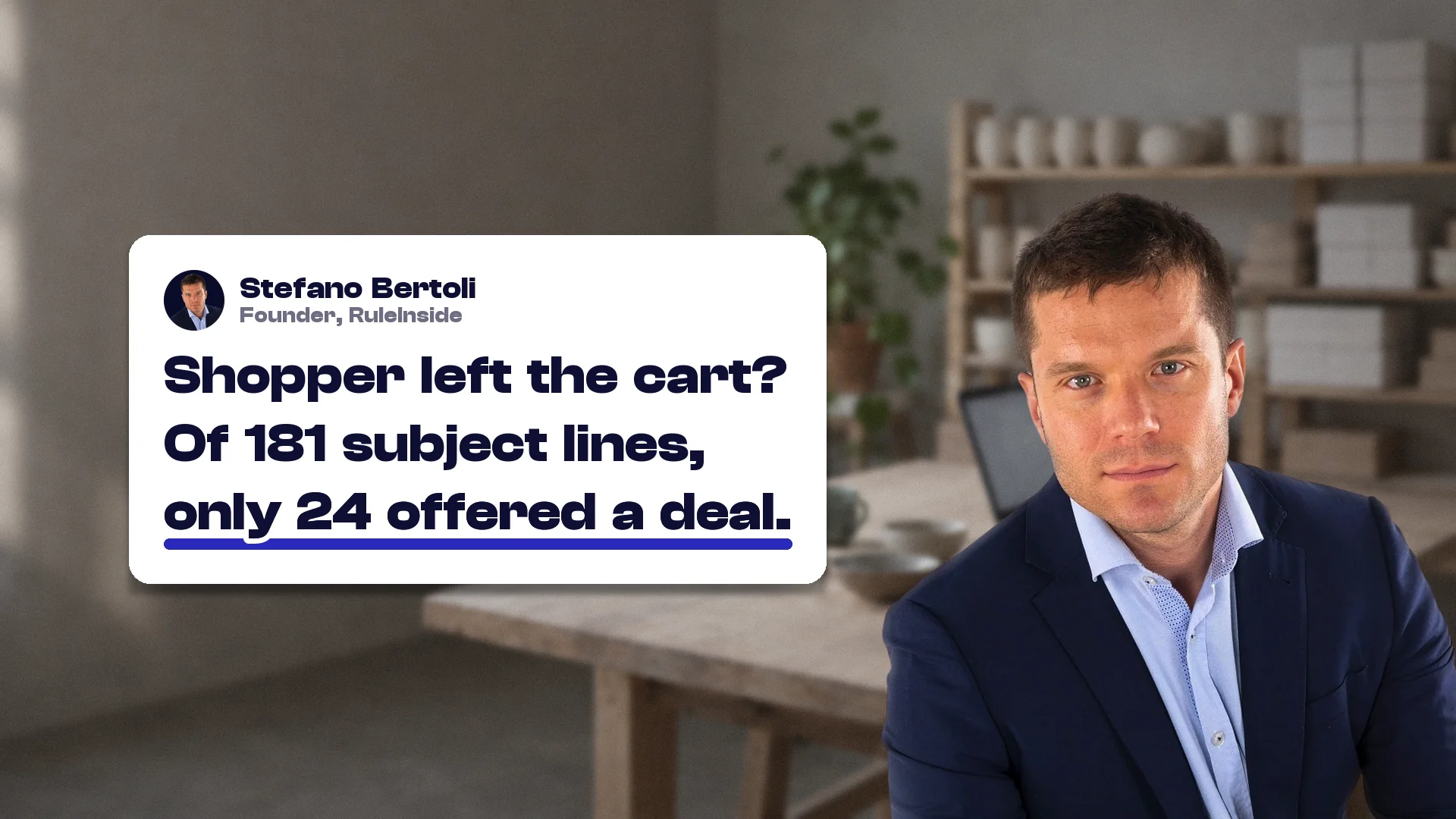
- Only 24 of the 181 offered a deal, yet every article I read from Google’s first page discusses discounts.
- Opens are no longer a fair test, because Apple Mail can hide them. Judge a subject line by clicks and orders.
- A cart email reaches only shoppers who typed an email address. Answering shoppers while they are on the page reaches everyone.
What makes an abandoned cart email subject line work?
Before anyone opens your email, they see three things: who sent it, the subject line and the preview text. Litmus, which sells email testing software, calls these three the email’s envelope: its first impression.[2] The subject line does one job. It gets the email opened. The email then has to earn the click, and the cart page has to earn the order.
It helps to know what a cart email usually achieves. Omnisend reported its users’ results for 2025: 35.75% of delivered cart emails were opened.[3] Only 1.51% resulted in a conversion. Klaviyo’s 2026 report covers more than 110,000 of its customers. It puts the average click rate of an abandoned cart email at 6%.[4] Both companies sell the software that sends these emails, so read the figures as their customers’ averages.
At Omnisend’s rate, 1,000 cart emails bring about 15 conversions. That is real money for an email that sends itself once set up. It also shows the limit. Most shoppers who receive the email still do not buy, whatever the subject line says.
What a good one does
A good subject line says plainly what is inside: the cart, the product, or help with the order. It sounds like your other emails, so the shopper knows who is writing. And it matches the email, so the shopper who opens finds what the line promised. In the US, that last point is a legal rule, not only good manners. The law section below explains why.
Bottom line: an abandoned cart email subject line wins the open; the email and the cart page win the order.
What did 181 real stores put in their subject lines?
Every list of abandoned cart email subject lines on Google’s first page is a writer’s selection. I wanted the opposite: what stores send when nobody is writing a listicle. Really Good Emails keeps a public gallery of abandoned cart emails from real brands.[1] It held 231 when I read it on 9 October 2026.
I kept the 181 sent by brands that sell physical products online. Apps, software, streaming, travel, restaurants and publications were left out. Then I tagged what every subject line does, and checked each tag by hand.
Our count of Really Good Emails' abandoned cart gallery. It shows what stores sent, not which lines worked.
The typical subject line is short: a median of 28 characters, or 5 words. 146 of the 181 were 40 characters or fewer. The plain reminder was the most common move, in 68 lines. A question came next, in 52.
The moves that the articles on Google’s first page treat as categories of their own were rare. Only 24 of the 181 offered a deal: money off, free shipping or a gift. 21 used urgency, and just 8 used the shopper’s first name. Yet all six of the top-ranking articles I could read discuss discounts, and five discuss urgency. Among the 68 emails added to the gallery from 2023 to 2026, only 6 offered a deal.
A gallery is curated, so this is not a random sample. Most senders are well-known consumer brands. The year is when an email joined the gallery, not when it was sent. And I see each subject line, not its results. So these counts show what stores send, not what works.
Bottom line: real abandoned cart email subject lines are short and plain. Most remind or ask, and few discount.
Reminder subject lines: say what happened
Reminders are the plainest abandoned cart email subject lines. A reminder tells the shopper what the email is about. It is honest by design, and it was the most common choice in the gallery. These are real examples, with the brand and the year each was added:[1]
- Brew Tea Co, 2024: “Your tea is right where you left it.”
- Medly, 2024: “Hey, you left some really good wine behind”
- Gantri, 2026: “Your light’s still here. Take another look.”
- Molekule, 2020: “You left something behind”
- Bombinate, 2021: “We saved your bag!”
- Loop Earplugs, 2026: “Your cart is waiting for you”
- Huckberry, 2023: “Your cart’s aging like a fine bourbon”
- Chewy, 2017: “Forgot something?”
The weakest reminders are the generic ones. 16 of the 181 were a version of the same line: you forgot something. Your shopper has probably seen that line from other stores already.
The stronger ones name the thing: tea, wine, a light. That costs nothing. It tells the shopper this email is about their cart, not one more promotion. Huckberry’s bourbon line shows that a brand voice can carry a reminder too, without a discount.
How to write yours
Say what was left. Use your customer’s word for it: the tea, the boots, the order.
Keep it short. Most of the real ones fit in 40 characters.
Sound like your other emails. The shopper should know who wrote it before opening.
Promise only what the email shows. A reminder that opens on a sale banner breaks its word.
Bottom line: the plain reminder is the default for a reason. It says exactly what the email is.
Question subject lines: ask, and be ready for the answer
52 of the 181 abandoned cart email subject lines asked a question. 14 of those asked whether the shopper forgot or left something. The more useful ones offer help:[1]
- Haoma, 2022: “Any questions?”
- Rarify, 2025: “How can we help?”
- Specialized Bicycle Components, 2021: “Trouble Checking Out? Get Free Express Shipping”
- Fiorucci, 2024: “Still deciding?”
- Pestie, 2024: “Did a bug crash your order?”
A question that offers help fits a cart abandoned because of a doubt. The shopper may have wanted to check the size, the delivery time or the returns policy. A question invites them to say which. Pestie’s line blames a glitch, not the shopper.
A question also creates work. A shopper who replies to ask whether it runs small expects an answer, and soon. Check where replies to your cart emails go before you send one. If the emails come from a no-reply address, a question subject line asks for an answer you will never see.
Make sure the email itself helps answer the question, too. “Still deciding?” works when the email then gives a reason to decide: the size guide, the delivery date range, the returns window. A question with nothing behind it is only a softer reminder.
Bottom line: a question subject line works best when someone is ready to answer the reply.
Subject lines that name the product or the shopper
Only 26 of the 181 abandoned cart email subject lines named the product, or the kind of product. It is the most specific move available, and it shows at a glance that the email is about their cart:[1]
- Aventon, 2025: “Need more time? Your ebike is still here (for now).”
- Perigold, 2020: “The Kitchen Canister is in your cart →”
- 23andMe, 2018: “Your DNA kit is waiting for you”
- Le Puzz, 2022: “Missing a puzzle?”
Naming the product needs your email tool to pull the product’s name from the cart. Long names break the short format. A full name with size and colour can run well past the 40 characters most of the real ones use. A product type works as well: a puzzle, an ebike, a DNA kit. Aventon’s line does three things in 10 words: it asks, names the product and adds a light deadline.
The first name was the rarest move: 8 of 181. Five of the eight pair the name with a question, as in “Hey Smiles Davis, did you forget something?” (Homes Alive, 2022). Smiles Davis is the gallery’s stand-in for the subscriber’s own name.
If you use the first name, set a fallback for when the field is empty. Otherwise the line opens with a greeting and a blank where the name should be. And name the product first. A first name says who the email is for, while the product says what it is about.
Bottom line: name the thing they left, and add the first name only with a fallback.
Subject lines with an offer or a deadline
Three of the six top-ranking articles on Google give discounts and urgency a category of their own. In real abandoned cart email subject lines they were the exception: 24 deals and 21 urgency lines out of 181.[1] Here are some of each:
- Eve Lom, 2021: “Complete your order with $15 off”
- Fable, 2025: “Free Shipping, Just For You 🕊”
- United By Blue, 2021: “Oh hey, great taste. Free shipping on $150+”
- Alo Yoga, 2025: “ALMOST GONE: Supernatural Sweater Cardigan”
- Nomad, 2020: “Nomad Gear is Selling Out Quick”
When should a discount appear? Meettie, which sells shopper identification software, advises against one in the first email. In its words, a discount there “is unnecessary and can reduce profits”.[5] It suggests keeping any incentive for the second or third email, and for segments such as first-time shoppers.
Urgency has one hard rule: it must be true. Alo Yoga’s “ALMOST GONE” is honest only if the stock count says so. A deadline you invented is a misleading subject line, and the law section explains why that matters.
If you do offer something, put its condition where the shopper can see it. United By Blue’s line states the $150 minimum in the subject line itself. A shopper who opens for free shipping and finds a hidden minimum feels tricked, and that feeling lands on your brand.
Bottom line: use an offer or a deadline when it is real, and state its conditions in the line.
How long should the subject line be, and what goes in the preview text?
Keep abandoned cart email subject lines near 30 characters. The 181 real ones had a median of 28 characters, and 146 of them used 40 or fewer.[1] Put the important words first, in case a phone cuts off the end. Brew Tea Co’s line starts with “Your tea”, so even a cut line says what the email is about.
The preview text
The preview text is the line shown after the subject. Litmus says email clients typically pull it from the first lines of your email if you leave it empty.[2] A few pull an image’s alt text instead. Either way, the inbox decides what your shopper reads. Litmus recommends keeping preview text under 90 characters.
Use it to finish the subject line’s thought. Litmus shows an abandoned cart email from Rudy’s that does this. The subject is “Don’t let free shipping go to waste”. The preview text reads “Let us make it easier with free shipping”.[2] The two lines work as one sentence.
Emoji
21 of the 181 used an emoji.[1] Gmail’s sender guidelines draw the line that matters: “Don’t use emojis or other non-standard characters to imitate graphic elements in messages”. The ban covers emoji used with the intent to deceive or influence recipients.[6] An emoji that adds tone, like the dove in Fable’s free-shipping line, sits on the right side of that line. One that fakes a badge or a warning does not.
Bottom line: keep abandoned cart email subject lines near 30 characters, and finish the thought in the preview text.
What does the law say about a cart email's subject line?
In the US, abandoned cart email subject lines are not only a marketing choice. The CAN-SPAM Act bars a commercial email whose sender knows the subject heading “would be likely to mislead a recipient”.[7] The test is whether the line misleads about a material fact regarding the email’s contents. Avoid a deadline that does not exist. Avoid a line that implies an order the shopper never placed.
Is a cart email commercial at all? The Act’s transactional category covers an email whose primary purpose is “to facilitate, complete, or confirm a commercial transaction”. The recipient must have “previously agreed to enter into” that transaction.[8] Whether an abandoned cart counts as a transaction the shopper agreed to is a question for your lawyer.
The FTC’s rule adds a test that turns on the subject line. An email may mix an ad with transactional content. It counts as commercial if someone reading the subject line “would likely conclude that the message contains the commercial advertisement or promotion”.[9] So a subject line that leads with a discount points towards the email counting as commercial.
A commercial email must carry three things: a clear ad notice, a way to opt out, and a valid physical postal address.[7] The ad notice does not apply when the recipient gave prior affirmative consent.
Gmail adds its own rule for every sender. Subject lines “should accurately represent the sender identity and message content”. Its example: no “Re:” or “Fwd:” unless the email really is a reply or a forward.[6]
I am not a lawyer, and this is not legal advice. If your cart emails carry offers, ask yours how they are classed.
Bottom line: an honest subject line passes the law’s test as well as the reader’s.
How do you test a subject line when the open rate is unreliable?
Five of the six top-ranking articles on abandoned cart email subject lines talk about open rates. Apple changed what that number means. Apple says its Mail Privacy Protection “prevents senders from seeing if you’ve opened the email message they sent you”.[10]
In 2021, Litmus explained how this plays out. Apple routes each email through a proxy server and pre-loads its content, tracking pixels included, even when the reader never opens it.[11] So an open from an Apple Mail user may be no open at all. Litmus’s advice was to report clicks and conversions as well.
The benchmarks have moved the same way. Klaviyo’s 2026 abandoned cart report prints click rates and revenue per recipient. It prints no open rate for the flow.[4] If your dashboard shows a high open rate and few orders, the open rate may be the number that is wrong.
A test you can trust
Change one thing. Test one subject line against another, with the same email behind both.
Split the first email. It is the one most shoppers receive, so the test gathers results fastest.
Judge by orders per email sent. Clicks come next. Opens come last, if at all.
Wait for orders, not days. A small store may need weeks to see a difference worth trusting.
Write it down. Keep the line, the dates and the orders, so the next test starts from a result.
Bottom line: test abandoned cart email subject lines on clicks and orders, because opens no longer show who read them.
When should each cart email go out, and how many?
Send the first cart email 2 to 4 hours after the cart is left. Send 2 to 3 emails in all, across 24 to 72 hours. The articles on Google’s first page agree on that pattern, though the advice comes from companies that sell marketing software. Klaviyo gives the timing for the first email, and suggests a second 24 to 48 hours later.[12] Meettie advises 2 to 3 emails across 24 to 72 hours.[5]
Each email can carry a different subject line. Klaviyo suggests the second can be “a bit more salesy”, or carry a personal offer.[12] A simple order works: the first reminds, the second offers help, and a third, if you send one, can carry the offer.
Your tools also decide when a cart counts as abandoned. Shopify’s original checkout recovery calls a checkout abandoned if it is still incomplete 10 minutes after the customer gives an email.[13] AutomateWoo, a WooCommerce extension, marks a cart abandoned after 15 minutes without activity, unless you change it.[14]
What WooCommerce sends on its own
WooCommerce 11.0 includes an experimental abandoned cart recovery email.[15] It is disabled by default. It sends one reminder, with a link to finish paying for the order. Automatic sending waits until an eligible order has stayed in Pending payment for two hours.
It needs a valid billing email address, and it never sends twice for one order. Its settings include a Subject field. So everything this guide says about abandoned cart email subject lines applies to it.
One email is fewer than the articles on Google’s first page advise. For a second or third, you need an extension or an email tool. WooCommerce itself says to test the feature before turning on automatic emails on a live store. Send yourself the email first, and read its subject line as a shopper would.
Bottom line: send the first email within hours and stop after two or three; on WooCommerce, check what your store sends today.
Who never gets your cart email, and what reaches them?
Every subject line in this guide reaches one group only: shoppers who typed an email address. Shopify’s original recovery email needs one. It cannot be sent to a shopper who entered only a phone number.[13] WooCommerce’s needs a valid billing email.[15]
Many carts end before that point. Our guide to KPIs for ecommerce and the cart abandonment rate explains the two numbers below. Across 423 Shopify stores, the analytics company Littledata found a median cart abandonment of 79% of sessions that added to cart.[16] The median checkout completion was 52%, across 425 stores.[17] These are different stores and different steps, so do not combine them. But a cart that ended before checkout left you no address to write to.
So the bigger lever sits before the email. A shopper with a question can be answered while still on the page, with no email or phone number needed. Our guide to AI agents for ecommerce makes the same point: start with answering.
For shoppers who did leave a number, a call can follow. Our AI shopping assistant calls within the hour when the store has the customer’s number. If not, an email goes at once. In the US, that call needs consent first. The FCC ruled in 2024 that AI-generated voices count as artificial voices under the Telephone Consumer Protection Act (TCPA).[18] FCC rules require telemarketers to get prior express written consent before such calls.[19] We build that consent step into the store’s checkout.
Bottom line: abandoned cart email subject lines reach only shoppers who gave an email, so answer the rest before they leave.

Free download · your next step
Check the Email Flows Behind Your Cart Emails
With the Ecommerce Marketing Audit, you score 22 areas of your marketing from 0 to 10. Three of them cover what this guide is about.
- Process Automation: whether your email flows run without needing you at every step
- Personalization: whether everyone gets the same page, the same email and the same offer
- Promotion: the message you send, to whom and when
It is free, and you do the scoring. What I build improves 3 of the 22 areas, and the audit names which.
Get My Marketing AuditQuestions Store Owners Ask About Abandoned Cart Email Subject Lines
The best abandoned cart email subject lines say plainly what the email is about. In our count of 181 real subject lines, 38% used a plain reminder and 29% asked a question.
Name the product where you can, as Aventon does with “Your ebike is still here”. Offer help with a line like “Any questions?” Keep it near 30 characters.
Two or three is the usual advice. Klaviyo suggests a first email 2 to 4 hours after the cart is left, and a second 24 to 48 hours later.
Klaviyo sells email software, so treat this as a vendor’s advice. WooCommerce’s own experimental recovery email sends one, so a second or third needs an extension.
It depends, so ask a lawyer. CAN-SPAM’s transactional category covers emails that facilitate, complete or confirm a transaction the recipient previously agreed to enter into.
The FTC’s rule adds a subject-line test for mixed emails. If the subject line reads like an ad, the email counts as commercial. A discount in the subject line points that way.
An abandoned cart can be any cart left behind. An abandoned checkout is one where the shopper reached checkout and, on Shopify, gave an email.
Shopify’s original checkout recovery counts a checkout as abandoned 10 minutes after the customer gives their email. WooCommerce’s recovery email works on a pending order with a billing email.
Yes, for the shoppers they reach. Omnisend reports that 1.51% of its users’ delivered cart emails resulted in a conversion in 2025.
Klaviyo reports a 6% average click rate and $6.77 revenue per recipient for cart emails in 2026. Both are vendors reporting on their own customers.
Within hours. Klaviyo advises sending the first email 2 to 4 hours after the cart is left.
WooCommerce’s experimental email waits until an order has stayed in Pending payment for two hours. Shopify’s original checkout recovery counts a checkout as abandoned after 10 minutes.
There is no fair one any more. Apple’s Mail Privacy Protection stops senders from seeing whether its users opened an email.
Omnisend still reports 35.75% for its users in 2025, but Klaviyo’s 2026 report prints no open rate for the flow. Judge your subject lines by clicks and orders.
Rarely in the first email. Only 24 of 181 real store emails offered a deal in the subject line.
Meettie advises keeping any incentive for the second or third email. If you offer one, state its condition, as United By Blue does with “Free shipping on $150+”.
Yes, since WooCommerce 11.0, as an experimental feature that is off by default. It sends one reminder per order.
It needs a valid billing email, and the order must stay in Pending payment for two hours. Its Subject field is yours to write.
One can add tone, but it is optional. 21 of the 181 real subject lines used one.
Gmail’s guidelines ban emoji that imitate graphic elements to deceive or influence recipients. Never use one to fake a badge or a warning.

How I wrote this guide
Who wrote it. I did. I run RuleInside, which builds managed AI agents for WordPress stores. Our call-back agent is mentioned once, in the last section.
The subject lines. On 9 October 2026, I read all 231 emails in Really Good Emails’ abandoned cart gallery, using the gallery’s own data. I kept the 181 from brands that sell physical products online and tagged what each subject line does. Every tag was checked by hand, and wrong tags were removed before any share was counted.
The top-ranking articles. I read the 6 articles I could open among Google’s top results for “abandoned cart email subject lines”. Ubersuggest recorded them on 10 September 2026.
Owners. I read 43 Reddit posts about cart email subject lines and open rates. Then I checked who wrote the posts that made claims. Most of them had posted nothing else about running a store, copied a post word for word, or were promoting a channel. So this guide quotes none of them.
Sources. Each was opened on 9 October 2026. Where a figure or a tip comes from a company that sells software, the guide says so.
Updates. I revise this guide when a source changes. The date at the top shows the last real update.
Sources
- Really Good Emails, “The Best Abandoned Cart Email Examples & Designs”, read 9 October 2026. Our count of the gallery’s 231 emails. Read the source
- Litmus, “The Ultimate Guide to Email Preview Text”, 8 November 2024. Read the source
- Omnisend, “Abandoned Cart Email Examples, Templates & Tips That Work”, updated 22 September 2026. Read the source
- Klaviyo, “2026 Abandoned Cart Benchmark Report”, 2 October 2026. Read the source
- Meettie, “12 Abandoned cart email subject lines that actually recover sales”, read 9 October 2026. Read the source
- Google, “Email sender guidelines”, Gmail Help, read 9 October 2026. Read the source
- 15 U.S.C. 7704, CAN-SPAM Act, “Other protections for users of commercial electronic mail”, United States Code, 2023 edition. Read the source
- 15 U.S.C. 7702, CAN-SPAM Act, “Definitions”, United States Code, 2023 edition. Read the source
- Federal Trade Commission, CAN-SPAM Rule, 16 CFR 316.3, “Primary purpose”, 2024 edition. Read the source
- Apple, “Use Mail Privacy Protection on iPhone”, Apple Support, read 9 October 2026. Read the source
- Litmus, “What Mail Privacy Protection Means for Email Marketers”, 20 September 2021. Read the source
- Klaviyo, “12 Abandoned Cart Email Best Practices, with Real Examples”, read 9 October 2026. Read the source
- Shopify Help Center, “Recovering abandoned checkouts” (the original, legacy experience), read 9 October 2026. Read the source
- WooCommerce, “Abandoned Cart”, AutomateWoo documentation, read 9 October 2026. Read the source
- WooCommerce, “Abandoned cart recovery emails”, documentation, read 9 October 2026. Read the source
- Littledata, “Cart Abandonment Rate by Industry (2026)”, October 2026. Read the source
- Littledata, “Checkout Completion Rate Benchmark by Industry (2026)”, October 2026. Read the source
- Federal Communications Commission, Declaratory Ruling FCC 24-17, released 8 February 2024. Read the source
- Federal Communications Commission, news release on AI-generated voices in robocalls, 8 February 2024. Read the source
On this page