

You bought the AI tool to answer your customers. The setup took longer than promised, so it runs on defaults. Then a policy changes, and it keeps giving the old answer. You find out from a customer.
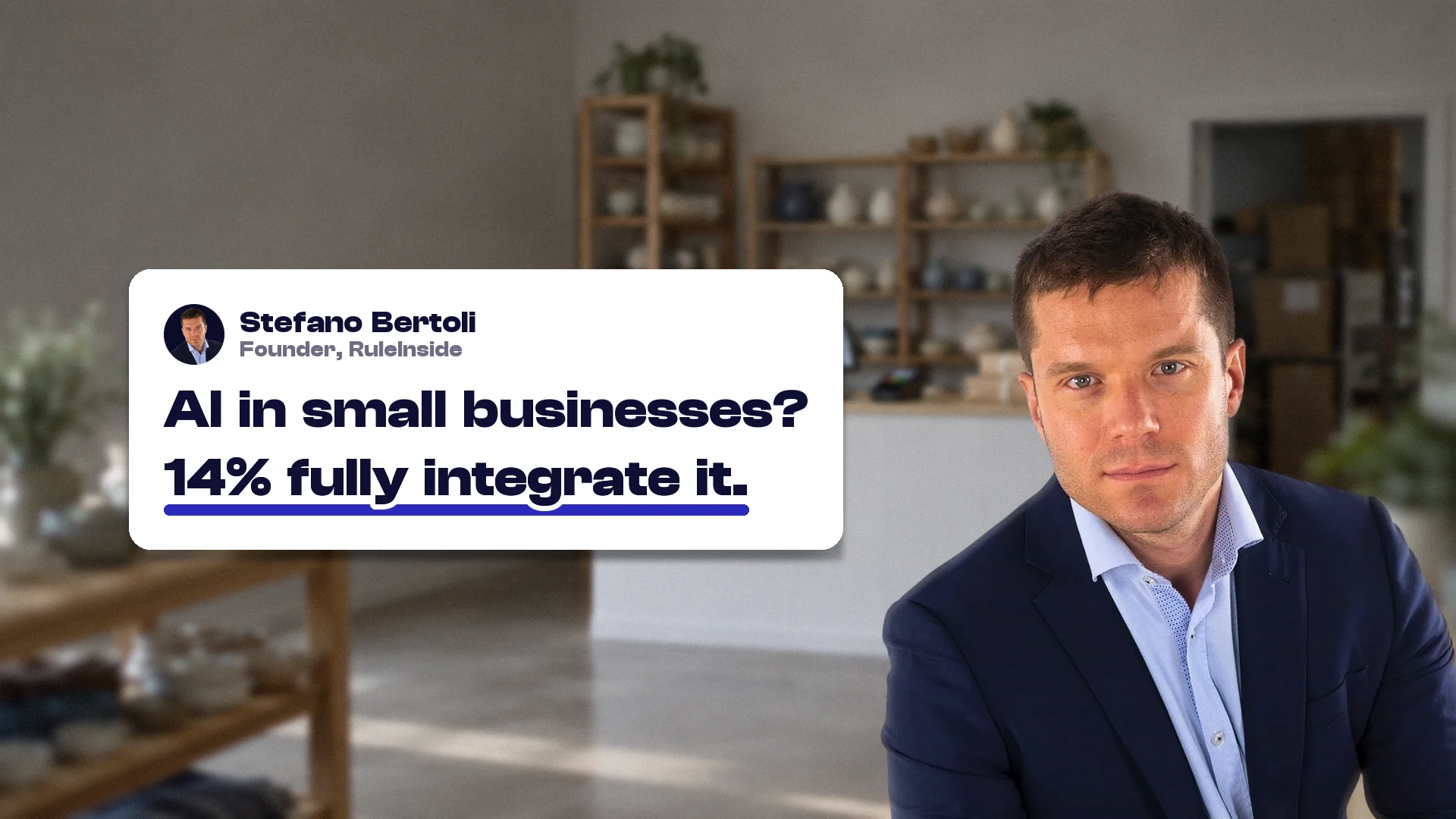
You are not alone in that gap. In a Goldman Sachs survey published in March 2026, 76% of small businesses said they use AI. Only 14% fully integrate it into core operations.[1] Managed AI is one answer to that gap: someone else runs the AI for you.
I build managed AI voice and chat agents for WordPress stores. I lead every deployment personally, and my team runs the infrastructure. RuleInside also sells a self-serve plan you set up and run yourself, so I sell both sides of this comparison. Read the guide with that in mind.
Key takeaways
- Managed AI means a provider sets up, runs and fixes the AI for you. You approve the rules and keep the decisions.
- Running an AI agent is weekly work: updates, reading conversations, fixing wrong answers and handing over to a person.
- Your store answers for what its AI says. A tribunal held Air Canada to its chatbot’s wrong answer.
- Choose managed AI when the questions repeat and nobody has the hours to run a tool well.
What is managed AI?
Managed AI is an AI system that a provider sets up, runs and keeps working for you. For an online store, that usually means the AI agent that answers your customers. The provider connects it to your products, orders and policies, then keeps watching it.
The word “managed” comes from IT. Gartner’s glossary says the term now covers “any continuous, regular management, maintenance and support”.[2] Managed AI applies that idea to AI: you buy the result, and the provider does the upkeep.
Managed AI or managed IT?
If you searched “managed AI”, most of what you found was written for IT teams. Of the 18 pages we could read on page one, 11 were written for IT people. Not one mentioned an online store.
Those pages mean AI inside managed IT services, or a provider running AI tools for a company’s staff. None shows an AI agent answering a business’s own customers. This guide means something narrower. It is the AI that talks to your customers, run by someone who answers to you.
Bottom line: managed AI for a store means someone else runs the agent that answers your customers, and you stay in charge.
Managed AI or a DIY AI tool: who does what?
Most AI agents sold to stores are self-serve. You connect the store, write the rules, test the answers and read the conversations. A managed service does the same work, but the provider does it. The table shows where each job lands.
| The job | DIY AI tool | Managed AI |
|---|---|---|
| Connect products, orders and policies | You | The provider |
| Write the rules and the tone | You | The provider drafts, you approve |
| Update it when something changes | You, when you notice | The provider, when you tell them |
| Read the conversations | You, if you have time | The provider, on a schedule |
| Fix a wrong answer | You | The provider |
| Decide refunds and exceptions | You or your team | You or your team |
The last row is the same on both sides, on purpose. A good agent answers and looks things up. A person decides anything with money in it.
Neither is better in general. A DIY tool suits a store with someone who has the hours and enjoys the work. Managed AI suits a store where nobody does. Our guide to the best AI customer service agents for WooCommerce stores compares both models, agent by agent.
Bottom line: both models do the same work. The question is whose hours it costs.
What does running an AI agent take, week to week?
The work does not end at launch. An AI agent that answers customers needs the same care as a new member of staff. Most of it is small, and all of it is regular.
Keep it current. New products, price changes, a new returns window or a delivery delay.
Read the conversations. Not the totals, the actual answers, to catch the wrong ones early.
Fix what it got wrong. Change the source it read, not just the one reply.
Tune the handover. Decide which questions go to a person, and check they arrive with the conversation attached.
Watch the channels. Chat, email and phone each need their own checks.
Report what changed. So you can see what the agent did, and why it was adjusted.
This is where many small businesses stall. In the same Goldman Sachs survey, 49% of businesses using AI named a lack of technical expertise as a challenge. 73% said they would benefit from more training and resources to implement AI.[1] The survey covers small businesses in general, not only stores.
None of this needs a developer every week. It needs someone who owns it. In a DIY setup that is you. In a managed setup it is the provider, and you read a short report.
Bottom line: price an AI agent by the hours it takes to run, not only by what it costs to buy.
Why does it matter who runs the AI?
Forecasts about AI in customer service are bold. Gartner predicts that by 2029, AI agents will resolve 80% of common customer service issues on their own.[3] That is a forecast, not a measurement. The same firm also predicts a pull the other way. By 2027, it expects half of the organisations that planned big support staff cuts to abandon those plans. In its poll of 163 service leaders, 95% planned to keep human agents.[4]
The best-known real case is more careful. In February 2024, Klarna said its AI assistant handled two-thirds of its customer service chats in its first month. It called that “the equivalent work of 700 full-time agents”.[5] The same release said customers could still reach a live agent if they preferred.
By May 2025, Klarna was hiring human customer service agents again.[6] Its chief executive told Bloomberg, “there will always be a human if you want”.[6] Klarna did not drop AI. One report noted that it “remains bullish on AI”.[7]
For a store, the lesson is simple. The AI does the volume. Someone has to watch it, improve it and step in. If that someone is you, budget your hours. If it is a provider, check they really do it.
Bottom line: an AI agent works best with a person behind it. Decide who that person is before you launch.
Who answers for a wrong answer?
You do. In 2024, a Canadian tribunal ruled on a case about Air Canada’s website chatbot. It had told a customer they could apply for a bereavement fare retroactively. The airline’s own bereavement page said otherwise.
Air Canada argued it could not be held liable for what its chatbot said. The tribunal disagreed: “It should be obvious to Air Canada that it is responsible for all the information on its website. It makes no difference whether the information comes from a static page or a chatbot”.[8] The tribunal ordered Air Canada to pay $650.88 in damages, plus interest and fees.
The amount was small. The principle is not. Whatever your AI agent tells a customer, your store said it.
That is the strongest reason to care who runs the agent. Someone must read what it says, catch the wrong answers and fix the source. The same logic sets the limit on what an agent should do alone. Let it answer and look things up. Keep refunds, discounts and exceptions with a person.
Bottom line: your store is responsible for every answer its AI gives, so make sure someone reads them.
When does managed AI fit a store, and when does it not?
Managed AI is not for every store. It fits a specific situation, and it is the wrong buy outside it.
It fits when
- Customers ask the same questions every day: delivery, stock, sizing, order status.
- Nobody on your team has the hours to run and check an AI tool.
- You want a person to answer for the agent, not a help page.
It fits badly when
- You get a handful of questions a day and answer them well yourself.
- You enjoy configuring tools and have the time to read every conversation.
- Most questions need judgement, not information.
A common piece of advice gives stores a path. First a help desk and some automation, then a dedicated virtual assistant, then an outsourced team or an in-house one.[9] Managed AI sits beside the assistant on that path. It takes the repeated questions, and a person keeps the rest.
If you are weighing a person or an outside team instead, read our guide to outsourcing customer service. It compares in-house, outsourced and AI support for stores.
Bottom line: choose managed AI for repeated questions and missing hours, not for work that needs your judgement.
What should a managed AI service include?
“Managed” is an easy word to print on a sales page. These checks show whether a provider means it. Ask each one in writing.
Setup on your own data. Your products, orders and policies, connected and tested before launch.
A stated time for changes. How fast an update goes live after you ask.
Conversations read by a person. How often, and what they do with a wrong answer.
A clear handover. Which questions reach you, and with what attached.
Limits on money. The agent never approves a refund, a discount or an exception alone.
A regular report. What the agent handled, and every change the provider made.
Your data stays yours. The setup, knowledge and conversations leave with you if you go.
A way out. The notice period, and how you export your data.
For reference, here is what our managed AI services page promises. Knowledge updates within 24 hours, and transcripts read, not only totals. A weekly report, and 30 days to export your data if you leave. Hold us to the same list.
The same questions work for a DIY tool. The difference is who has to answer them: the vendor, or you.
Bottom line: a managed AI service should name who reads the conversations, how fast it changes, and what stays with you.

Free download · your next step
Check any AI provider before you sign, mine included
The AI Agent Buyer’s Guide turns these checks into questions you can ask in a sales call.
- A 13-point checklist that scores any vendor out of 13.
- Six ways to handle support compared side by side, from doing it yourself to a managed agent.
- What to ask about the answers your data cannot give.
- One section on what I build, labelled so you can skip it.
It scores my own agent on the same 13 points, and marks the ones I cannot yet claim in full.
Get the Free AI Agent Buyer's GuideQuestions Store Owners Ask About Managed AI
What is managed AI?
Managed AI is an AI system that a provider sets up, runs and maintains for you. For an online store, it is usually the agent that answers customers. The provider keeps it current and fixes it; you approve the rules and keep the decisions.
What are managed AI agents?
Managed AI agents are AI agents run for you by a provider rather than by your own team. They answer customers from your products, orders and policies. The provider reads their conversations and updates them, and hands harder cases to a person.
What is the difference between managed AI and a DIY AI tool?
The difference between managed AI and a DIY AI tool is who does the running work. With a DIY tool you connect it, update it and read its answers. With managed AI the provider does that, and you approve the rules.
Is managed AI the same as managed IT services?
Managed AI is not the same as managed IT services. Managed IT runs a company’s systems, networks and devices. Managed AI, for a store, runs the AI that talks to your customers. Many pages about managed AI are written for IT teams.
How do you manage AI agents?
You manage AI agents by keeping their information current, reading their conversations and fixing the source of any wrong answer. You also tune which questions go to a person and track what changed. A managed provider does this for you.
Who is responsible when an AI agent gives a wrong answer?
The business is responsible when its AI agent gives a wrong answer. In 2024 a Canadian tribunal held Air Canada to its chatbot’s answer. Make sure someone reads the conversations and that refunds stay with a person.
Can AI manage my store's customer emails?
AI can answer many of your store’s customer emails, such as order status, stock and policy questions. It should hand anything involving money or judgement to a person. Someone also has to check its answers, which is what a managed service covers.
Does managed AI replace my support staff?
Managed AI does not have to replace your support staff. It takes the repeated questions and lookups, so your people handle the cases that need judgement. Someone on your side still makes the decisions about money.
When should a store choose managed AI over doing it itself?
A store should choose managed AI when questions repeat every day and nobody has the hours to run an AI tool well. If you have few questions or enjoy the setup work, a DIY tool or answering yourself may suit you better.
What should a managed AI service include?
A managed AI service should include setup on your own data, a stated time for changes and conversations read by a person. It also needs a clear handover, limits on money, a regular report, and your data back if you leave.

How I wrote this guide
Who wrote it. I did. I run RuleInside, which sells managed AI agents and a self-serve plan, both sides of the comparison above.
Page one. I read the pages that rank for “managed AI” in the US and the UK on 3 October 2026. Of the 19 results, 18 could be read, and I counted who each was written for.
Every other figure. Each links to its source below, and each source was opened and read. Gartner’s figures are forecasts and a poll, and the text says so.
Updates. I revise this guide when a source changes. The date at the top shows the last real update.
Sources
- Goldman Sachs 10,000 Small Businesses Voices, “AI Presents a Major Opportunity for Small Businesses: But Support Is Needed to Close the Implementation Gap”, 17 March 2026. Open source
- Gartner, “Managed Service Provider (MSP)”, IT Glossary. Open source
- Gartner, “Gartner Predicts Agentic AI Will Autonomously Resolve 80% of Common Customer Service Issues Without Human Intervention by 2029”, 5 March 2025. Open source
- Gartner, “Gartner Predicts 50% of Organizations Will Abandon Plans to Reduce Customer Service Workforce Due to AI”, 10 June 2025. Open source
- Klarna, “Klarna AI assistant handles two-thirds of customer service chats in its first month”, 27 February 2024. Open source
- Entrepreneur, “Klarna CEO Reverses Course By Hiring More Humans, Not AI”, 9 May 2025, reporting the chief executive’s interview with Bloomberg. Open source
- Maginative, “Klarna Dials Back its AI Customer Service Strategy: Now It’s Hiring Humans Again”, 8 May 2025. Open source
- Civil Resolution Tribunal of British Columbia, “Moffatt v. Air Canada”, 2024 BCCRT 149, 14 February 2024. Open source
- rshrivastava63, “How are you handling customer support once it grows past you personally?”, Shopify Community, 5 August 2026. Open source
On this page