


“Im running 6 figure Shopify store running Gorgias for support. However, we still burn around 5 hours just copy-pasting tracking links/handling these support tickets”. A store owner wrote that on Reddit.[1] The support tool was paid for. The work was still there.
I spent the last year testing AI voice platforms against real stores, then built RuleInside. It is one of the agents compared here, so read this knowing I sell one.
This guide compares the AI customer service agents a WooCommerce store can actually use. It judges each AI customer service agent on five things. They are your orders, the handover to a person, the channels, who runs it, and what it may do alone. There are no prices here. Each company’s own page has current ones.
Key takeaways
- Only a few AI agents read WooCommerce orders without a developer. Several popular ones are built for Shopify.
- The handover decides the result. A person and a bot together resolved 57% of issues, against 29% for bots alone.
- Choose by who will run it. A self-serve agent is a new job for your team. A managed one is a service.
- Let the agent answer and look things up. Keep refunds, discounts and order changes with a person.
What is an AI customer service agent?
An AI customer service agent is software that answers your customers by chat, email or phone, using your store’s own data. A good one also looks things up, like an order’s status. It hands the conversation to a person when it should.
The difference from a chatbot is what it reads. A classic chatbot follows a script or a list of FAQs. An agent reads your live products, stock and orders, so “where is my order?” gets the real answer.
It is not a help desk either. A help desk is the inbox your team answers from. Some help desks now include an AI agent, and some agents plug into a help desk.
On WooCommerce, the test is simple. Ask the AI customer service agent about a real order number and see what comes back.
Bottom line: an agent is only as good as the store data it reads and the person it hands over to.
How I compared the agents
I read the 11 pages that rank for this search in the US and the UK. None of them mentions WordPress. WooCommerce appears on two, each time as one word in a list of integrations.
So I checked each AI customer service agent on its own website and help pages, on 30 September 2026. Each one answers the same five questions. They come from the checklist I give buyers, which scores my own agent too.
Does it read your WooCommerce orders? Natively, through a connector, or not at all.
How does it hand over to a person? With the conversation attached, and on which channels.
Where does it answer? Website chat, email, messaging apps, the phone.
Who builds and runs it? Your team, or the vendor.
What may it do on its own? And what stays with you.
I run RuleInside, one of the agents below. It is described with the same five questions, limits included. Every claim about another product links to that company’s own page.
Bottom line: judge an agent by what it can read in your store and how it lets a customer reach you.
Which AI customer service agents work with WooCommerce?
The agents fall into three groups on WooCommerce. A few read your orders out of the box. Several popular ones need a connector you build. Some are built for Shopify only.
| Agent | Reads WooCommerce orders | Answers the phone | Who sets it up |
|---|---|---|---|
| Octocom | Yes, through its WooCommerce extension | Yes, voice is listed | You, with an account manager |
| RuleInside | Yes | Yes | We do, or you on the self-serve plan |
| Re:amaze AI Agent (beta) | Yes, per its AI Agent guide | Not found | You |
| Zendesk AI agents | Yes, through an action flow you set up | Yes | You, with an optional paid service |
| Freshdesk Freddy AI Agent | Listed as a workflow integration | Not found | You |
| Tidio Lyro | Only with a custom Action you build | Not found | You |
| Intercom Fin | Only with a data connector you configure | Yes, Fin Voice | You, with a deployment team |
| Chatbase | No WooCommerce integration found | Yes, through Twilio or your own line | You |
| Gorgias AI Agent | No, its docs say not supported | Not found for the AI Agent | You |
| Consio | No, Shopify only | Yes | Partly done for you |
| Ringly | No, Shopify is its only store platform | Yes | You |
| Callsy | For outbound calls on WooCommerce events | Yes, outbound first | You |
| Frontdesk | Claimed on one page, not in its help centre | Yes | You |
Checked on each company’s own website and help pages on 30 September 2026. “Not found” means I looked and found no statement either way.
Bottom line: on WooCommerce, check that an agent reads your orders before you compare anything else.
The AI customer service agents, one by one
Each entry answers the same five questions, in the company’s own words where it matters. Links go to the page that says it.
Octocom
Best for: a WooCommerce store that wants an agent to act on orders in chat, email and messaging.
Octocom has an extension on WooCommerce.com. Its listing promises “Order tracking, returns, and updates handled automatically”.[2] Its homepage lists address updates and order cancellation for WooCommerce among the agent’s actions.[3]
It answers across chat, voice and email.[3] If stuck, it passes the conversation to your help desk or email, “complete with all customer details”.[2] Setup is guided by a dedicated account manager.[2]
Check: its WooCommerce.com listing says it was tested with WooCommerce 9.1 and WordPress 6.7.[2] Ask which versions they support now.
RuleInside
Best for: a WooCommerce store that wants the phone answered and has nobody to run an agent.
This is mine, so weigh it accordingly. It reads your live WooCommerce data: products, stock, orders and tracking. It answers by voice, the site widget, chat, WhatsApp and email. Instagram and Messenger are not built yet. The details are on our AI customer support and AI voice agent pages.
On a call, it transfers the customer live to your phone or team. It does not change orders. Anything that moves money stops and comes to you.
It is managed: we connect the store, build it on your catalogue and policies, and run it. A self-serve plan exists if you would rather build it yourself.
Check: it is new, with no published results yet. Ask to hear it handle your own questions before it goes live.
Re:amaze AI Agent
Best for: a store that already uses Re:amaze as its help desk.
Re:amaze has a native WooCommerce integration for its help desk.[4] Its AI Agent guide lists “WooCommerce products/orders” among the agent’s sources, across chat, email and SMS.[5]
Check: the AI Agent is labelled beta[6], and a second Re:amaze article lists only Shopify orders as a source.[7] I found no voice for the AI Agent. Ask which is current.
Zendesk AI agents
Best for: a store already on Zendesk, with someone to build workflows.
On 4 September 2026 Zendesk added a WooCommerce connector for its action flows. It can look up and search orders, customers and products.[8]
Zendesk’s help centre says its agentic AI agents work on messaging, email and voice.[9] On calls, they escalate to a person, and every call creates or updates a ticket.[10]
Check: the connector’s action list has no order edit, cancel or refund.[8] It is new, so ask what is live on your plan.
Freshdesk Freddy AI Agent
Best for: a store already on Freshdesk.
Freshdesk lists WooCommerce among the integrations its AI agent workflows can use: fetch order details, update order status and manage cancellations.[11] Freddy answers on email, web chat, WhatsApp and social, and hands over “with full context”.[12]
Check: the WooCommerce support rests on one row of an integrations table. I found no WooCommerce setup guide for Freddy, and no voice on its page.
Tidio Lyro
Best for: a store that wants a chat agent quickly and can build an order lookup.
Tidio installs on WooCommerce as a WordPress plugin. Its homepage claims “live Shopify and WooCommerce order and product data”.[13] On WooCommerce, though, order lookup means a custom Action, which Tidio says “is meant for advanced users or developers”.[14]
Lyro answers chat, email and messaging apps, and can pass “the entire conversation” to your inbox during your online hours.[15] I found no phone or voice.
Intercom Fin
Best for: a store with a developer and an Intercom help desk.
Fin reads WooCommerce data through a data connector, an API call you configure yourself.[16] Fin’s shopping features on WooCommerce are in closed beta, and Intercom says: “You’ll need a developer.”[17]
Fin works across voice, chat, email and more, and hands off “maintaining full customer context”.[18]
Chatbase
Best for: a store that wants a general AI agent and can connect its own API.
I found no WooCommerce integration in Chatbase’s docs. Its WordPress plugin embeds the chat widget.[19] WordPress.org flags that plugin as untested with the last three major WordPress releases.[20]
Order data would need a Custom Action on an API you provide.[21] Chatbase can answer phone calls through Twilio or your own line.[22]
Gorgias AI Agent
Best for: Shopify stores. On WooCommerce, the help desk works but the AI Agent does not.
Gorgias’s compatibility table marks its AI Agent “Not Supported” on WooCommerce.[23] On WooCommerce, your team sees order data in the help desk, but “You can’t initiate any actions on WooCommerce orders”.[24]
Check: Gorgias’s WooCommerce page promises AI order updates and edits.[25] Its help docs, several updated this month, say otherwise. Ask which applies to your store.
Consio
Best for: Shopify stores that want the phone answered.
Consio’s getting-started guide opens with connecting Shopify, which it says is required.[26] I found no WooCommerce support on its site or help centre.
Ringly
Best for: Shopify stores that want the phone answered.
Ringly lists Shopify as its only store platform.[27] It says its phone agent “can call any API during a call”, so a custom WooCommerce link may be possible.[27] Ask before you plan on it.
Callsy
Best for: outbound calls, such as abandoned checkouts, rather than answering questions.
Callsy’s WordPress plugin connects WooCommerce abandoned checkouts to phone calls. It also lists order-status calls, renewal reminders and post-purchase calls.[28]
Check: I found no web chat and no inbound order support. Its page says to download the plugin from WordPress.org, where a search found none.
Frontdesk
Best for: small businesses of many kinds that want an AI receptionist.
Frontdesk’s WooCommerce page claims a native integration with order, customer and product sync.[29] Its help centre lists 11 integration guides, including Shopify, and none for WooCommerce.[30] It can transfer calls to a person, on rules you set.[31]
Check: ask to see it answer a WooCommerce order question. The demo on its WooCommerce page is a rental enquiry.
Bottom line: the agents that read WooCommerce orders without a developer are few, so start your shortlist there.
Why the handover matters more than the answer
Every page that ranks for this search mentions the handover to a person. The research shows why it decides the result.
57%
of issues resolved when a person and a bot worked together, against 29% for bots alone.[32]
Contentsquare, 2026
53%
of refund conversations resolved when a person was involved, against 18% for bots alone.[32]
Contentsquare, 2026
87%
of customers say a company using generative AI for service must offer a way to reach a person.[33]
Gartner, 2026
Contentsquare sells experience analytics, so read its figures as a vendor’s. Gartner surveyed 3,566 business and consumer customers.[33]
A wrong answer is your store's answer
In 2024 a Canadian tribunal ruled on advice from an airline’s chatbot. The chatbot suggested a customer could claim a bereavement fare after travelling. Air Canada did not allow that.[34]
Air Canada argued it could not be held liable for its chatbot’s information. The tribunal called this “a remarkable submission”. It found that Air Canada “did not take reasonable care to ensure its chatbot was accurate”, and ordered it to pay CA$812.02.[34]
A store is in the same position. What your agent tells a customer, your store told them.
Angry customers need a person fast
Researchers studied a telecoms company’s chat data and ran four experiments. When customers arrived angry, a more human-like chatbot lowered their satisfaction and their intention to buy again. For customers who were not angry, it did not.[35]
Human-like means qualities such as a name or an avatar. The researchers trace the harm to expectations: the friendlier bot promises more than it delivers. So send complaints and damaged orders to a person at once.
Bottom line: judge an agent by how quickly a customer reaches a person, not by how many it keeps away.
What should an AI agent never do on its own?
An agent should answer and look things up. Anything that moves money or changes an order needs a person’s decision, at least until the agent has earned that trust.
Give these to the agent
- Where is my order?
- Stock, sizes and product details
- Delivery ranges and your returns policy
- Taking the details of a problem
Keep these with a person
- Refunds and discounts
- Order changes and cancellations
- Complaints and damaged goods
- Anything legal or safety related
Refunds show why. Bots alone resolved 18% of refund conversations, against 53% when a person was involved.[32] An AI customer service agent can still take the details and pass them on, so the customer never repeats themselves.
Ask each vendor to list everything its agent can do without a person approving it. A short, confident list is a good sign. A long or vague one is not.
Bottom line: the agent answers and looks up; a person decides anything with money in it.
Chat, email or phone: where should it answer?
Most AI customer service agents start in a chat window on your website. Your customers may not start there.
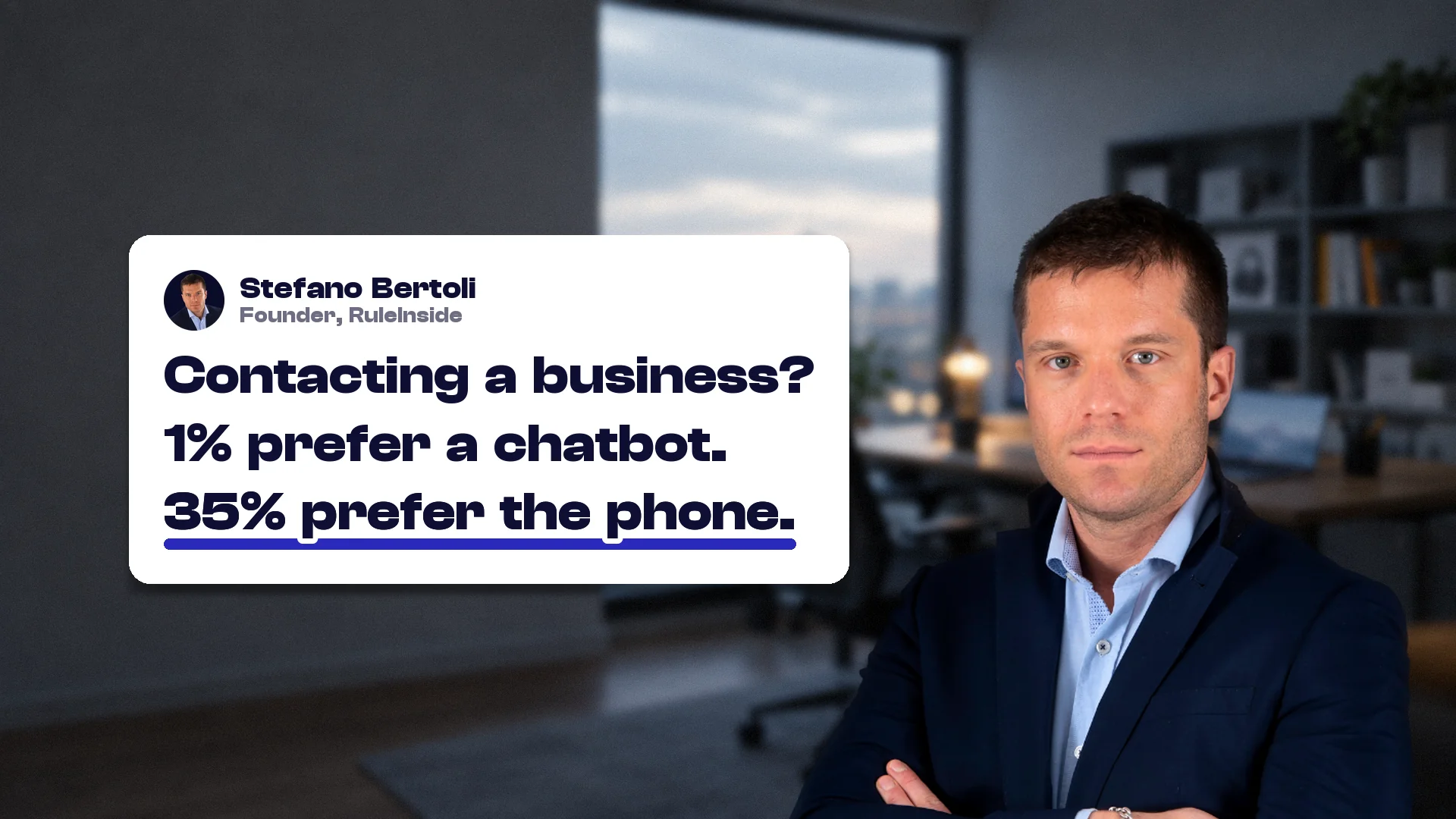
In a 2025 YouGov survey, 35% of Americans preferred to reach a business by phone. Email took 23% and live chat 10%. Only 1% preferred chatbots.[36] In Britain, email and phone are close: 33% prefer email and 31% the phone.[37]
Our guide to customer support for ecommerce covers what customers ask and how fast they expect an answer.
So check two things. Does the agent answer your phone, or only a website widget? And does its handover work on every channel it answers?
On a call, a handover means a live transfer to you or your team. In a chat, it means the conversation reaches a person with everything already said attached. We cover the phone side on our AI voice agent page.
Also ask whether one conversation carries across channels. A customer who called on Monday should not have to start again in chat on Thursday.
Bottom line: put the agent where your customers already ask, and test the handover on each channel.
Self-serve or managed: who runs the agent?
Most agents on this search are self-serve. You connect your store, write the rules, test the answers and read the conversations. When your catalogue or policy changes, you update the agent.
That suits a store with someone who has the time. It is a new job, not a finished one. Ask a self-serve vendor what happens when an answer is wrong: who notices, and how fast it is fixed.
A managed AI customer service agent is set up and run by the vendor. You approve the rules and can read every conversation. The vendor keeps it current and fixes it when it is wrong. Our guide to managed AI for online stores sets out that work, week to week.
Ask a managed vendor what stays with you. It should be the rules, the approvals and the final word on money.
If you are weighing a person or an agency instead, read our guide to outsourcing customer service.
None of the 11 pages that rank for this search asks who will run the agent. For a store with no support team, it is the first question.
Bottom line: price the time to run the agent, not only the agent.
Do you have to tell customers it is an AI?
In the EU, yes. Since 2 August 2026, the provider must make sure people know they are talking to an AI.[38] The exception is when that is obvious to a reasonable person. If you sell outside the EU, check the rules where your customers live too.
The duty sits with the provider, usually the vendor. Ask where its agent says it is an AI, and in which words. Only one of the 11 ranking pages raises the question at all.
Disclosure also sets expectations. In the angry-customer research above, the harm came from a bot that promised more than it delivered.[35] A plain first line, such as “I am the store’s AI assistant”, keeps the promise honest.
Then ask one more thing. After that first line, can a customer reach a person just by asking? Disclosure and a clear way out work together.
Bottom line: ask to see the agent’s first line before you sign.
Which AI customer service agent fits your store?
Start from what your store already has, and who will run the AI customer service agent. Then check the list above against these cases.
- You already use a help desk. Try its own agent first, if it reads WooCommerce orders: Zendesk, Re:amaze and Freshdesk say theirs can. On Gorgias, the AI Agent needs Shopify.
- You want orders handled in chat and email. Octocom reads WooCommerce orders through its extension and can update addresses and cancel orders.
- Your customers call. Check voice and the WooCommerce link together. Octocom, Zendesk and RuleInside list both; Fin and Chatbase need a connector.
- You have a developer. Tidio, Fin and Chatbase can reach your orders through an API you connect.
- Nobody has time to run it. A managed agent is set up and run for you. RuleInside is one; I built it, so compare it on the same five questions.
- You are moving to Shopify. Gorgias, Consio and Ringly are built for it, and this guide is not the right lens.
Whichever you pick, run the demo on your own questions. Ask it about a real order, then ask it something it cannot know.
Bottom line: the right agent reads your orders, reaches a person fast, and has someone running it.

Free download · your next step
Score any AI agent before you sign, mine included
The AI Agent Buyer’s Guide turns this comparison into questions you can ask in a sales call.
- Seven things vendors won’t tell you about AI support, each tied to a question.
- A 13-point checklist that scores any vendor out of 13.
- Six ways to handle support, compared side by side.
- Five questions that are really tests, for the sales call.
It scores my own agent on the same 13 points, and marks the ones I cannot yet claim in full.
Get the Free AI Agent Buyer's GuideQuestions Store Owners Ask About AI Customer Service Agents
What is an AI customer service agent?
An AI customer service agent is software that answers customers by chat, email or phone from your store’s own data. It looks up orders and products, and hands the conversation to a person when it should.
It differs from a chatbot because it reads live data instead of a script. It differs from a help desk because it answers, not only routes.
How is an AI agent different from a chatbot?
An AI agent reads your live store data and can look things up. A classic chatbot follows a script or a list of FAQs. Ask an agent “where is my order?” and it checks the order.
The line is not the word on the box. Ask the vendor which systems the agent reads during a conversation, and whether it is a live read or a nightly copy.
Can AI do customer service for an online store?
AI can do the repeat part of customer service for an online store: order status, stock, sizes, delivery ranges and policies. It needs to read your store’s live data to do it well.
It should not decide refunds, discounts or order changes on its own. Contentsquare found bots alone resolved 18% of refund conversations, against 53% with a person involved.
Will AI replace customer service agents?
AI will replace some customer service work, not the people who handle judgement. The research points to a person and a bot together, not a bot alone.
Gartner predicts that by 2027, half of the organisations that planned big AI cuts to service staff will drop those plans.[39] In stores, the agent takes the repeats and a person keeps the exceptions.
Can an AI agent answer phone calls?
Yes, an AI voice agent can answer your store’s phone calls, from your products and orders. Many AI agents only work in a website chat window, so check before you buy.
On a call, the handover should be a live transfer to you or your team. Ask the vendor to show you one.
Which AI customer service agents work with WooCommerce?
AI customer service agents that read WooCommerce orders out of the box include Octocom, RuleInside and Re:amaze (in beta). Zendesk added a WooCommerce connector in September 2026.
Tidio, Intercom Fin and Chatbase need a connector you build. Gorgias, Consio and Ringly are built for Shopify. Checked on each company’s pages on 30 September 2026.
Is an AI customer service agent worth it for a small business?
An AI customer service agent is worth it for a small business when the same questions take hours every week. If most questions need judgement, a person is still the better answer.
Count your repeat questions for one week first. Then weigh the agent against who else would answer them, and include the time to run it.
What should an AI agent never do on its own?
An AI agent should never decide a refund, a discount or an order change on its own. It can take the details and pass them to a person.
Complaints and damaged orders should also reach a person quickly. Research on angry customers found a human-like bot made them less satisfied, not more.
Do customers need to be told they are talking to an AI?
In the EU, customers must be told they are talking to an AI, unless it is obvious. The rule applies from 2 August 2026 and falls on the provider, usually the vendor.
Ask the vendor where the agent says it is an AI, and in which words. The disclosure should come in its first line.
How do you choose an AI customer service agent?
Choose an AI customer service agent on five things. Does it read your orders, and how does it hand over? Where does it answer, who runs it, and what may it do alone? Features and model names come after.
Test the handover in the demo, on every channel. Ask to see the agent say “I don’t know” and pass the conversation to a person.

How I wrote this guide
Who wrote it. I did. I run RuleInside, which builds and runs managed AI agents, one of the options compared here.
The products. I checked each agent on its own website, help pages and app listings on 30 September 2026. I describe what each company says its product does; I did not buy and test every one. There are no prices, by choice: they change, and each company’s page has them.
Page one. I read the 11 pages that rank for this search in the US and the UK, and counted what they cover.
Every other figure. Each links to its source below, and each source was opened and read. Several come from companies that sell support software, and the text says so.
Updates. I revise this guide when a product changes. The date at the top shows the last real update.
Sources
- A post on r/shopify, 12 November 2025. Open source
- Octocom, “Octocom AI Agent for WooCommerce”, WooCommerce.com extension listing. Open source
- Octocom, homepage. Open source
- Re:amaze, “WooCommerce: How-To” help article. Open source
- Re:amaze, “How to use the Re:amaze AI Agent”. Open source
- Re:amaze, homepage. Open source
- Re:amaze, “Understanding where your AI Agent gets its answers”. Open source
- Zendesk, “Announcing a new action builder connector for WooCommerce”, 4 September 2026. Open source
- Zendesk, “About AI agents with agentic AI”. Open source
- Zendesk, “About voice AI agents”. Open source
- Freshdesk, “Workflows for AI agents”. Open source
- Freshworks, Freddy AI Agent. Open source
- Tidio, homepage. Open source
- Tidio, “Lyro Actions”. Open source
- Tidio, “Lyro, the conversational AI agent”. Open source
- Fin, WooCommerce connector. Open source
- Intercom, “Set up Fin for Ecommerce on any ecommerce platform”. Open source
- Fin, homepage. Open source
- Chatbase, WordPress integration docs. Open source
- WordPress.org, Chatbase plugin. Open source
- Chatbase, “Custom Action” docs. Open source
- Chatbase, “Channels” docs. Open source
- Gorgias, “Compatibility of automation features with ecommerce store providers”. Open source
- Gorgias, “WooCommerce 101”, updated 27 January 2026. Open source
- Gorgias, WooCommerce. Open source
- Consio, “Getting started”. Open source
- Ringly, integrations. Open source
- Callsy, WooCommerce integration. Open source
- Frontdesk, WooCommerce AI integration. Open source
- Frontdesk, help centre: integrations. Open source
- Frontdesk, “Call Transfer Workflows” help article. Open source
- Contentsquare, “Digital Experience Benchmark: Conversations”, 2026. Open source
- Gartner, press release, 4 August 2026: 87% of customers want access to a human agent. Open source
- Moffatt v. Air Canada, 2024 BCCRT 149, British Columbia Civil Resolution Tribunal, 14 February 2024. Open source
- Crolic, Thomaz, Hadi and Stephen, “Blame the Bot: Anthropomorphism and Anger in Customer-Chatbot Interactions”, Journal of Marketing, 2022. Open source
- YouGov, “How Americans prefer to contact businesses for customer service”, 13 March 2025. Open source
- YouGov, “A deep dive into British customer service preferences”, 8 April 2025. Open source
- Regulation (EU) 2024/1689 (the AI Act), Article 50 (transparency obligations) and Article 113 (entry into force and application), Official Journal of the EU, via EUR-Lex. Open source
- Gartner, press release, 10 June 2025: 50% of organisations will abandon plans to cut service staff because of AI. Open source
On this page