

“Every single day I wake up to like 40 emails and dms asking where is my order”. A beauty store owner wrote that at about 150 orders a week.[1] The next line was the real question: “Anyone found a way to handle this that doesn’t involve hiring someone?”
I know that question from the inside. From 2018 to 2021 I ran EarthMeals, a plant-based ready-meals ecommerce brand in Italy. Every customer cost more in money, time and attention than the business could sustain. Since then I have consulted more than 30 businesses, and the ecommerce ones showed this problem worst.
This guide covers customer support for ecommerce from the owner’s side of the inbox. It covers what your customers ask, how fast they expect an answer, and who should answer them as your store grows. It is built on what store owners say, not on what support vendors sell.
Key takeaways
- Most questions are about an order or a product, and the answer already sits in your store.
- Owners tend to answer support themselves for a long time, then hire their own staff. Few use a virtual assistant.
- Owners report anything from half an hour to over four hours of support a day, so count yours before you decide.
- When a support hand-off went wrong in our research, the most common cause was product knowledge.
- Automate the repeat questions, keep a person for judgement, and keep every money decision with you.
What is customer support for ecommerce?
Customer support for ecommerce is answering shoppers before and after they buy. It runs by email, chat, phone and messaging apps. For most stores, the answers come from two places: your orders and your product pages.
That is what makes a store different from a call centre. A call centre answers from a script. A store answers from live data: where a parcel is, whether a size is in stock, what the returns policy says.
It also has two sides. Before the sale, a question is a buyer deciding. After the sale, it is a customer checking on money they already spent. Both land in the same inbox, and they are not the same job.
Gorgias, which sells a help desk, draws the same line: “A question asked after an order ships is a cost”.[2] A question asked before buying is a sale that has not happened yet. So the two sides need different things. Before the sale, you need speed and product knowledge. After it, you need accuracy and the order record.
Bottom line: ecommerce customer service is mostly lookups, and the lookups live inside your store.
What do ecommerce customers actually ask?
We read store owners’ own posts about support and counted the questions they say customers send.[3] Order status came first, named by 8 of the 12 owners who listed their questions.
Source: RuleInside owner research, 2026, hand-coded. Only confirmed store owners are counted. The sample is small, so read the order.
In a 2023 article, Gorgias, which sells a help desk, puts “where is my order?” at 18% of incoming requests.[4] It also finds that about 1 in 9 inquiries is a question asked before buying.[2]
Those buying questions matter more than their share suggests. One owner tagged 340 messages from 60 days and found most came before a purchase:[5]
“i had been staffing the inbox like it was a support channel. it was mostly a sales channel in disguise.”
One owner said “like 80% of what customers ask is stuff thats already written in the product descriptions”.[6] Specs, dimensions, compatibility and shipping times, asked again and again.
We cover the five questions that fill a store’s inbox on our AI customer support page.
Where is my order?
It is the most common question in ecommerce customer service.[4] A good answer gives three things: the order’s status, a working tracking link and the delivery range. The cheapest answer is the one sent before anyone asks.
One owner who was spending over four hours a day on support changed five things.[7] Two were about orders. They set an email auto-reply with an order status link and the FAQ. They also put shipping times on the product page, in the cart and in the confirmation email. After that change, they report “Where’s my order” tickets dropped 40%.
Delivery ranges and destinations
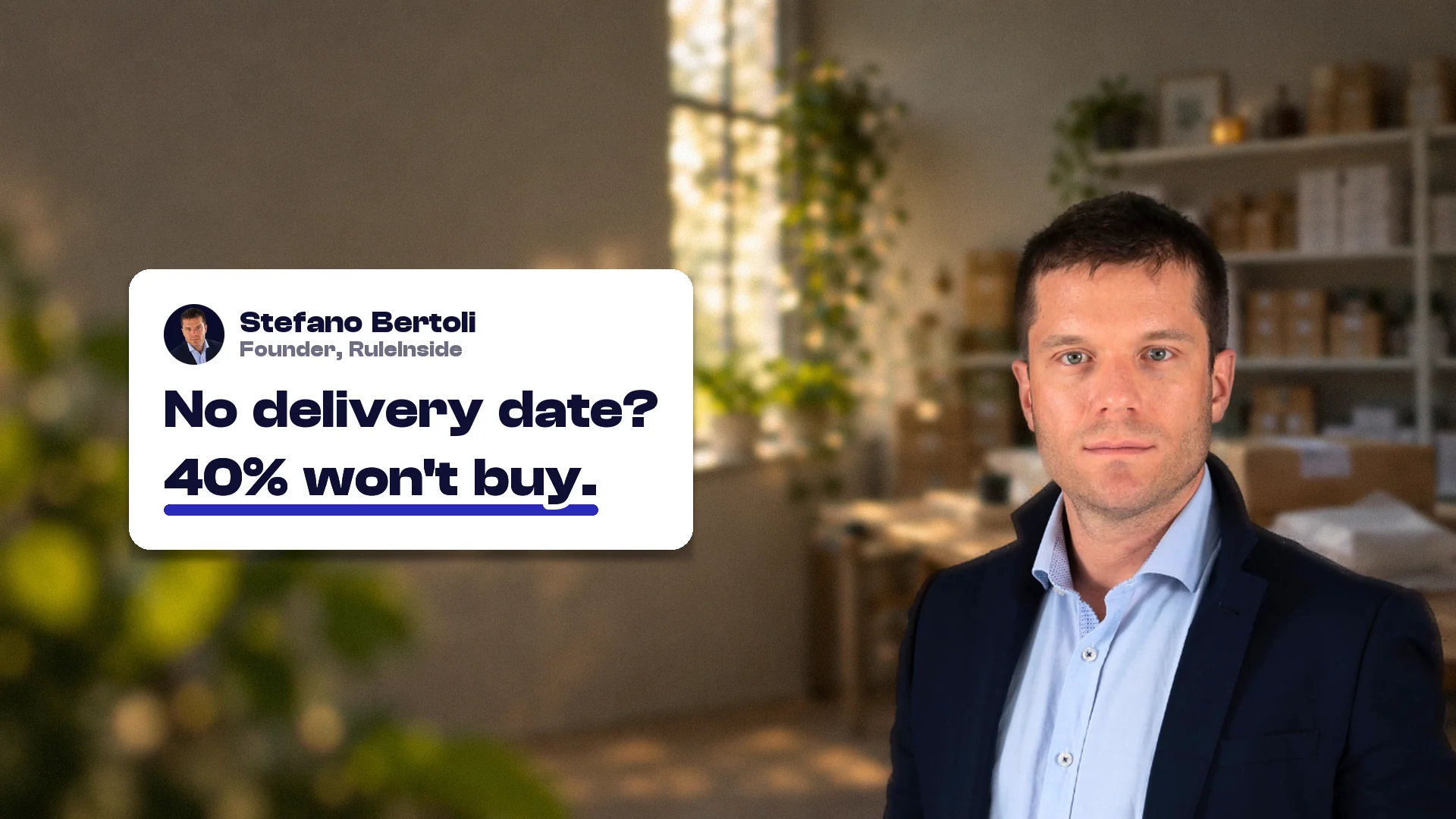
Shoppers ask about delivery before they buy, because delivery decides whether they buy. Narvar, which sells delivery tracking software, surveyed 3,461 US online shoppers in August 2025.[8] 73% said estimated delivery dates influence their purchases. If no date is shown, 40% won’t buy.
Baymard Institute asked 1,083 US online shoppers why they had abandoned a cart. 20% named delivery that was too slow.[9] So put a delivery range for each destination on the product page and in the cart. Then a buyer can answer the question without writing to you.
Returns and refunds
Buyers read the returns policy before they buy. Narvar found 90% check it first, and 76% won’t buy again after a poor returns experience.[8]
So answer returns questions with the policy’s own words, not a paraphrase. Keep one version of the policy and link to it from every product page. The refund itself is a decision about money, and it stays with you.
Product questions before buying
These are the questions a buyer asks when the product page did not answer them. One owner’s buyers asked about “ingredients, skin conditions, how to use the product alongside other things they were using”.[5]
Salsify, which sells product content software, surveyed 1,910 shoppers in the US and UK in October 2024.[10] Of those, 53% said incomplete or poorly written titles or descriptions make them abandon an online sale. An answer you give twice belongs on the product page, where the next buyer will look for it.
Bottom line: part of support is really sales, and most answers are already written somewhere in your store.
How fast do customers expect an answer, and where?
Customers expect speed, and they do not all want the same channel. The figures below cover what they prefer and how long stores actually take.
35%
of Americans prefer to reach a business by phone, against 23% for email and 10% for live chat.[11]
YouGov, 2025
74%
of consumers expect customer service to be available around the clock.[12]
Zendesk CX Trends, 2026
11 hrs
is the median wait when a question asked before buying goes to a human queue.[2]
Gorgias Ecom Lab, 2026
In Britain, email and phone are close: 33% prefer email and 31% the phone.[13] Only 1% of people in either country say they prefer chatbots.[11][13]
Stores mostly run on email anyway. Gorgias finds 85% of brands run support mainly through email, while chat grew 47% in two years.[14]
Speed varies widely by store. Across brands near $10M a year in sales, the median first reply takes 6.3 hours.[15] By sector, the median ran from 1.6 hours in hardware to 8.8 in apparel.
Zendesk and Gorgias both sell support software, and YouGov covers every sector, not only online stores. Read these as direction, not as targets.
Each channel asks something different of ecommerce customer service.
Email is where most stores run ecommerce customer service. It suits order problems, returns and anything that needs a photo or a document. Reply within hours, not days, and answer the whole question in one message.
Live chat
Chat is fast. Gorgias found chat 38 times faster than email on first response.[14] Satisfaction on chat was 2.5 points lower than on email, though. A fast answer is not always a good one, so chat needs the same product knowledge as email.
Phone
Phone is the channel Americans say they prefer most, at 35%.[11] It is also the hardest one to cover alone, because a caller cannot wait in an inbox. If you publish a number, say when it is answered.
WhatsApp and social messages
Messaging is growing fastest. On the same brands, Gorgias measured WhatsApp volume up 153% in two years.[14] Treat these messages like chat. They are often a buyer deciding, and they need an answer while the buyer is still there.
When questions arrive
Many buying questions arrive when nobody is working. Gorgias found the median brand gets 53% of its pre-purchase questions outside business hours.[16] It counts business hours as Monday to Friday, 9am to 6pm. In those hours the median first reply took 2.2 hours. After hours, it stretched to about 15.
Bottom line: answer on the channels your customers already use, and answer buying questions first.
How much time does ecommerce customer service take?
Time is the first cost of customer support for ecommerce, and owners who counted it give a wide range. It depends on orders, on the product, and on how much the pages already answer.[3]
At the low end, one owner spends “maybe 30m a day max”.[17] That owner keeps the most common queries in Shopify Inbox and updates the FAQ whenever a question repeats. Another owner, with about 50 orders a day going out, still answers all the emails personally.[18]
Higher up, the hours grow fast. A solo apparel owner tracked one week of support. They found 10 to 15 hours spent answering variations of the same questions.[19] The beauty store owner in the opening spent four hours a day.[1]
The apparel owner named the stage exactly. “Not enough workload to justify hiring someone full-time, but definitely too much to ignore as a solo founder.”
So count your ecommerce customer service time before you decide anything. Log every message for one week, with the minutes each one took. That number, hours a week, is what every option in the next section is measured against.
Bottom line: count one week of support hours before you decide who should answer.
Who handles customer support as your store grows?
Store owners ask this directly. One owner at $20k to $30k a month put it as a choice. “Are you still handling customer service yourself, or did you hire someone for that?”[20]
One common answer is a ladder, given by an operator in the Shopify Community.[21] First a help desk and automation, then a virtual assistant, then an outsourced team or an in-house department. What established owners report skips a rung.[3]
Source: RuleInside owner research, 2026, hand-coded. Only confirmed store owners are counted. A small sample, so read the order.
Owners go from answering it themselves straight to their own staff. Not one of these 12 uses a virtual assistant. And the next step they weigh most often is AI, not another person.
You, alone
Almost every store starts here, and many stay far longer than planned. The beauty store owner from the opening was still here at 150 orders a week.[1] What kept them there was money, not volume: “I’m not there yet financially.”
The cost is your time, and you can never switch it off. One owner wrote that support “keeps you tied to a computer even if you’re on a vacation or what not”.[22]
Family or a part-time helper
The next step is often someone close. One high six-figure brand runs on the owner, a spouse and a part-time helper:
“It’s just me and my wife splitting time doing everything ourselves. We contract out a part time customer service helper.”
Your own hire
This is where half the established owners in our sample landed. A hire knows your brand, learns your products and sits inside your tools.
It also brings new risks. One owner hired help for the basic questions, then a second person. A few months later, their “response rate is worse than when I was doing everything solo”.[6] Another needed cover fast when their only rep went on maternity leave.[23]
An outsourced team
Outsourcing buys hours and people without a hiring round. In our sample, it ran both ways: owners moved to agencies and back again.
Our guide on whether to outsource customer service covers it in full, including costs and what to ask.
An AI agent, with a person behind it
Four of the 12 established owners were weighing AI as their next step, twice as many as were weighing outsourcing. The risk is an answer it makes up, such as a discount that does not exist.
So the setup that works is narrow. The AI answers the repeat questions from your store data. A person handles judgement calls, and anything that moves money needs your approval. Who runs the agent is a separate choice, covered in our guide to managed AI.
RuleInside builds and runs managed AI agents, one of the options in this section, so weigh my view accordingly.
Bottom line: the question is not who is cheapest, but who can answer from your products and your orders.
Why do support hand-offs fail?
We read the hand-offs that owners said went wrong. The most common cause was simple: the person answering did not know the products.
| Who answered | What went wrong |
|---|---|
| An in-house hire | A customer was given the wrong dimensions on a top seller.[6] |
| An outsourced company | “their product knowledge wasn’t good,” so the owner trained people in-house.[24] |
| An outsourced company | The owner called its replies to texts and emails “super rude and annoying”.[25] |
| A help desk tool | A six-figure store still spent about 5 hours a week copy-pasting tracking links.[26] |
They do not know the products
This was the most common failure. One owner trained a new hire for about two weeks and walked them through the catalogue. Four months in, a customer was told the wrong dimensions on a top seller.[6] The dimensions were on the product page all along.
The fix is to brief from the store itself: the catalogue, the spec sheets and the live orders. A document written once goes stale the day a product changes.
Answers differ from person to person
With two people answering, the same owner found a second problem. At least three customers in two weeks emailed the owner directly because “they got different answers from my reps”.[6] Two of them stopped replying, and they were warm leads.
The fix is one written answer per common question, used by everyone who replies.
Nobody is there
The same owner’s inbox logs showed “stretches during work hours where neither of them is online”.[6] A customer opened a chat, waited, and left. Cover needs a schedule, and someone who picks up when the schedule has a gap.
A help desk routes the question faster. It does not answer it. An outside person answers from a document, and the document goes stale when your catalogue changes.
A wrong answer is a bad experience, and bad experiences cost repeat business. Qualtrics, which sells experience software, finds consumers cut spending after 58% of bad online retail experiences.[27]
Bottom line: whoever answers needs your catalogue and your live orders, not a script about them.
What are the best practices for ecommerce customer service?
These are the ecommerce customer service practices that owners in our research say worked for them. Most cost nothing but an afternoon.
- Save your common answers. One owner runs the whole business alongside a full-time job. They keep replies to common emails in a text expander app, and it “Saves us tons of time.”[28]
- Turn each repeat question into page copy. The top reply in a Reddit thread about support time was “Make note of the questions and update your FAQ page”.[29]
- Answer where the question is asked. Put the FAQ on the product page, not only on a separate page. Put shipping times in the cart and the confirmation email too.[7]
- Give sizes as measurements. One owner replaced S, M and L with “actual inches” and says return requests dropped.[7]
- Send the update before they ask. A shipping email with a tracking link answers “where is my order?” before it is written.
- Answer buying questions first. A question before purchase is a sale waiting. An order update can usually wait an hour.
Bottom line: write each answer once, and put it where the next customer will look.
Where do help desks, FAQ pages and AI fit?
Tools do not replace the decision about who handles ecommerce customer service. They change how much of the work reaches a person.
A help desk
A help desk puts every channel in one inbox and tracks each conversation. That is useful from the first hire onward. It still needs someone to write each answer. If you are choosing one, our guide compares Zendesk alternatives for online stores.
An FAQ page and better product pages
Owners disagree on whether an FAQ page cuts the load. One said: “I added an faq. […] Doesn’t matter, people still ask constantly.”[1]
Another filled the FAQ and every product page with the questions buyers ask. That “Cut down phone calls and emails by like 80-90%”.[30] So the fix is often the product page itself: put the answer where buyers decide.
AI that answers from your store
AI works on questions with a single right answer in your data: order status, delivery ranges, stock, sizes and policies. It works badly on complaints and exceptions. Our comparison shows which AI agents read your WooCommerce orders.
Customers still want a way to reach a person. Our outsourcing guide covers the research on where AI fits and where it does not.
Give these to AI
- Where is my order?
- Delivery ranges and destinations
- Stock, sizes and product details
- Your returns policy
Keep these with a person
- Complaints and damaged goods
- Refunds that need judgement
- Discounts and order changes
- Anything legal or safety related
Bottom line: automate the answers, not the decisions.
What should you measure?
You do not need a dashboard to start. Four numbers tell you whether customer support for ecommerce is working in your store.
- First reply time, split into questions before buying and after. The first kind is a sale waiting. Use the median, as the benchmarks do, so one slow weekend does not hide a fast week.
- Resolved on the first reply: the share of conversations that needed no follow-up. To count it, read your last 20 conversations and mark each one that ended after your first answer.
- Contacts per 100 orders. Take the messages in a month, divide by that month’s orders, and multiply by 100. Gorgias puts it at about 46 in electronics and about 20 in food and drink.[15]
- Hours per week spent answering, by you or by anyone else. Owners in our research reported anything from half an hour a day to more than four hours a day.[3]
The first two numbers tell you about quality. The last two tell you about load, and load decides who should answer.
Track them for one month before you change anything. The baseline shows which change actually helped.
Bottom line: measure speed, first-reply resolution and volume per order before you choose who answers.
How to set up customer support for ecommerce, step by step
This is the order I would follow to set up ecommerce customer service, whatever size the store is today.
Sort one week of messages. Mark each as before buying or after. The split shows how much of support is sales.
Fix the product pages first. Every answer you retype more than twice belongs on the page where buyers decide.
Write your money rules. Refunds, discounts and order changes stay with you until someone has earned that trust.
Set a reply target per channel. Phone and chat need minutes. Email can take hours, not days.
Decide who answers at your stage. You, a helper, a hire, an outside team or an AI agent with you behind it.
Brief them from the store. Your catalogue and your orders, not a document written once and forgotten.
Read ten conversations a week. You will spot wrong answers faster than any report shows them.
Review the four numbers monthly. Change one thing at a time.
Bottom line: fix what customers ask before you decide who answers it.

Free download · your next step
Measure your support before you change who runs it
The Ecommerce Store Audit is the seven-area sweep I charge for, written out so you can run it yourself.
- Scores service hours, response speed, conversation quality and channels, among seven areas.
- Puts a euro figure on each weak spot, and one Health Score out of 100.
- Ends with a ranked plan that names the two areas to fix first.
- Starts with a 5-minute, ten-question first pass.
It ignores a great deal on purpose: acquisition, pricing, positioning and your products.
Get My Free Store AuditQuestions Store Owners Ask About Ecommerce Customer Service
What is ecommerce customer service?
Ecommerce customer service is how an online store answers shoppers before and after they buy. It covers email, chat, phone and messaging apps. Most questions are about an order, a delivery or a product, so the answers come from the store’s own data.
Customer support for ecommerce differs from a call centre in one way. The answer is usually a lookup in your orders or your product pages, not a script.
Why is customer service important in ecommerce?
Customer service matters in ecommerce because many questions come from buyers still deciding. An unanswered question before checkout is often a lost sale, not just a slow reply.
It also protects repeat business. Qualtrics finds consumers cut spending after 58% of bad online retail experiences. Qualtrics sells experience software, so treat that as a vendor figure.
What do ecommerce customers contact support about most?
In ecommerce customer service, the most common question is order status: where is my order, and when will it arrive. Shipping times, returns and product questions before buying come next.
Gorgias, a help desk vendor, put order status at 18% of requests in 2023. In our own owner research, 8 of 12 owners named it. Most of these answers already sit in your order system.
How fast should an online store answer customers?
An online store should answer buying questions within minutes on phone and chat, and email within hours. The first kind is a sale waiting, and a late answer often arrives after the shopper has left.
For context, Gorgias measured a median first reply of 6.3 hours at stores near $10M a year. Buying questions sent to a human queue waited a median of 11 hours.
How do you improve ecommerce customer service?
To improve ecommerce customer service, start with the questions, not the team. Sort a week of messages into before and after buying. Then move the answers you keep retyping onto your product pages.
Next, set a reply target for each channel and write your money rules. Track first reply time, first-reply resolution and contacts per 100 orders every month.
When should a store owner hire someone for customer support?
Hire for customer support when answering takes hours every day and the questions need judgement. If most questions repeat, fix your product pages or automate them first.
In our research, established owners stayed alone longer than planned, often at several hours a day. Then most hired their own staff. The most common failure in the hand-offs we found was product knowledge, so brief any hire from your catalogue.
Should you outsource ecommerce customer service?
Outsource ecommerce customer service when you need more hours, languages or phone cover than you can staff. It works best for judgement calls, not for lookups an agent must do by hand.
The risk is product knowledge: outside agents answer from a briefing you keep current. Our guide on whether to outsource customer service covers costs, providers and the questions to ask.
What customer service software does an online store need?
Most online stores need a help desk that puts email, chat and social messages in one inbox. It should read your store’s orders, so whoever answers does not switch between tools.
Choose it by what it connects to, not by feature lists. On WooCommerce, check that it reads orders and customers from your store. A help desk routes questions; someone still has to answer them.
Can AI handle customer service for an online store?
AI can handle the repeat questions of an online store: order status, delivery ranges, stock, sizes and policies. It should answer from your live store data, not from general knowledge.
Keep complaints, refunds and anything that moves money with a person. Customers still want a way to reach one, and a made-up answer can cost more than a slow one.
How do you handle customer support on a WooCommerce store?
On a WooCommerce store, customer support starts with access to orders. Whoever answers needs to see order status, tracking and customer history without full admin rights.
WooCommerce’s Shop Manager role still opens settings, products and coupons. Give helpers a narrower role through a plugin, or connect a help desk or AI agent that reads orders only.

How I wrote this guide
Who wrote it. I did. I run RuleInside, which builds and runs managed AI agents, one of the options compared here.
The owner data. We read support threads from r/shopify, r/ecommerce and the Shopify Community, from our problem bank of store owners’ posts. We counted only authors who describe running their own store and sell nothing in the post. Vendors, and posts we could not confirm, were left out. The samples are small, so read the order, not the counts.
Every other figure. Each links to its source below, and each source page was opened and read. Several come from companies that sell support software, and the text says so where they appear.
Updates. I revise this guide when a source changes. The date at the top shows the last real update.
Sources
- A post on r/shopify, 13 November 2025. Open source
- Gorgias Ecom Lab, “Pre-purchase speed is a revenue lever most brands treat as a cost”, 28 May 2026. Open source
- RuleInside owner research: who answers support at established stores, and what went wrong, coded from our problem bank (2026). Method above. How I wrote this guide
- Gorgias, “What’s the secret to reducing WISMO requests?”, updated 13 November 2023. Open source
- A post on r/ecommerce, 21 May 2026. Open source
- A post on r/shopify, 24 February 2026. Open source
- A post on r/shopify, 25 December 2025. Open source
- Narvar, “New Narvar Report Finds Two-Thirds of Online Shoppers Feel Anxious After They Click ‘Buy'”, State of Post-Purchase 2025, 6 November 2025. Open source
- Baymard Institute, “50 Cart Abandonment Rate Statistics 2026”, reasons from a 2026 survey of 1,083 US adults. Open source
- Salsify, 2025 Consumer Research report, 953 US and 957 UK shoppers, October 2024. Open source
- YouGov, “How Americans prefer to contact businesses for customer service”, 13 March 2025. Open source
- Zendesk, CX Trends 2026. Open source
- YouGov, “A deep dive into British customer service preferences”, 8 April 2025. Open source
- Gorgias Ecom Lab, “Email isn’t dying. Chat is doubling. But it’s not that simple”, 19 May 2026. Open source
- Gorgias Ecom Lab, “Stop benchmarking against the average”, 1 April 2026. Open source
- Gorgias Ecom Lab, “Your team is sleeping on 53% of shopper questions”, 30 July 2026. Open source
- A reply in “How do you handle the time sink of customer service”, r/ecommerce, 1 December 2024. Open source
- KarenFaulkner, Shopify Community, 22 and 23 June 2026. Open source
- A post on r/shopify, 20 May 2026. Open source
- A post on r/ecommerce, 29 December 2025. Open source
- rshrivastava63, “How are you handling customer support once it grows past you personally?”, Shopify Community, 5 August 2026. Open source
- A post on r/shopify, 21 January 2026. Open source
- AndrewEdwards19, Shopify Community, 30 April 2024. Open source
- sthr, Shopify Community, 23 August 2025. Open source
- SamNYC109, Shopify Community, 7 June 2023. Open source
- A post on r/shopify, 12 November 2025. Open source
- Qualtrics XM Institute, “$3 trillion at risk due to bad customer experiences”, 12 November 2025. Open source
- A reply in “How do you handle the time sink of customer service”, r/ecommerce, 30 November 2024. Open source
- Another reply in “How do you handle the time sink of customer service”, r/ecommerce, 30 November 2024. Open source
- A reply in “How do you handle the time sink of customer service”, r/ecommerce, 30 November 2024. Open source
On this page